


Affiliate Tracking Software
Learn how affiliate tracking software records referrals, attributes conversions, calculates commissions, and supports program reporting and payouts.
13 min read
AffiliateMarketing
TrackingSoftware
+3
Affiliate software is a platform for running an affiliate marketing program. It connects partner referrals to conversions, applies attribution and commission rules, and helps businesses manage affiliates, reporting, and payouts. The features and integrations available depend on the platform and configuration.
Affiliate software is a platform for running an affiliate marketing program. It connects partner referrals to conversions, applies attribution and commission rules, and helps businesses manage affiliates, reporting, and payouts. The features and integrations available depend on the platform and configuration.
On this page
Affiliate software — also called affiliate marketing software, affiliate tracking software, or affiliate management software — is a system that lets a business create, run, and scale a commission-based referral program. At its core, it answers three operational questions:
Every other feature — dashboards, fraud detection, affiliate recruitment tools, branded portals — builds on top of those three functions.
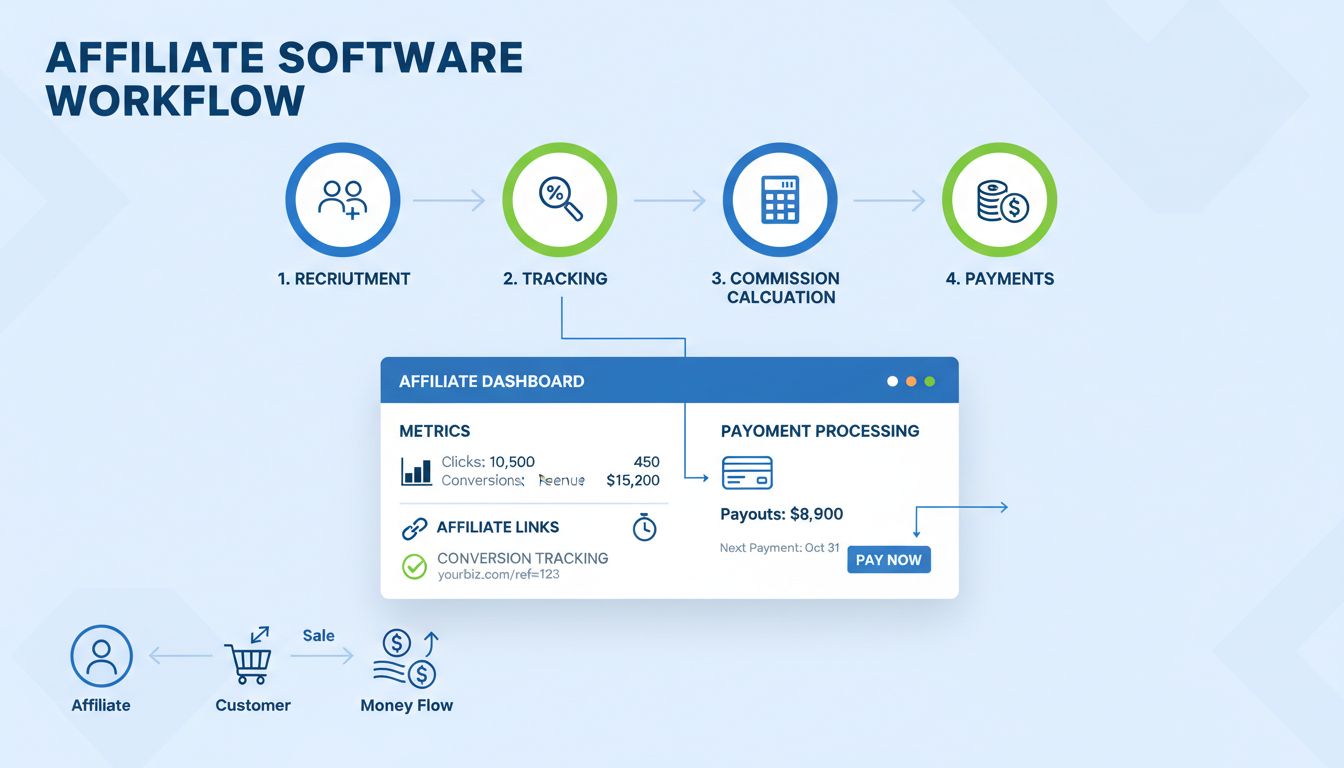
The software generates unique tracking links or promo codes for each affiliate. When a visitor clicks one of those links, the platform drops a cookie (or records a server-side event) that ties that browser session to a specific affiliate. If the visitor later completes a conversion — a purchase, a signup, a subscription — the software attributes the conversion to the correct affiliate, calculates the commission based on rules you’ve set, and logs it for payout.
This distinction causes more confusion than almost anything else in affiliate marketing, so let’s address it directly.
| Affiliate Software | Affiliate Network | |
|---|---|---|
| Who runs it | You (the advertiser) | A third-party company |
| Who owns the affiliate relationships | You — affiliates are your partners | The network — affiliates are shared across advertisers |
| Where affiliates find you | Your own recruitment efforts | The network’s marketplace |
| Cost structure | Flat monthly fee or one-time license | — |
| Branded experience | Fully white-label — looks like your brand | Network-branded portal |
| Control over terms | Complete — you set every rule | Negotiated within the network’s framework |
| Best for | Established brands wanting ownership and margin control | Brands wanting fast access to a large affiliate pool |
An affiliate network like Awin, CJ, or impact.com operates as an intermediary: they maintain a marketplace of affiliates, handle some compliance, and charge fees under their own commercial terms.
Both models are valid. Some companies use both: a self-managed program via affiliate software for their core partners, plus a presence on one or two networks for broader reach.
Affiliate software serves three distinct user types, each with different needs:
A well-designed affiliate platform gives each of these users a role-specific interface, so affiliates see only the information intended for their role. Program managers can handle routine tasks through the interface; integrations may still require technical support.

Set up advanced tracking in minutes. No credit card required.
When an affiliate shares a link and someone clicks it, the software needs to remember that relationship — sometimes for hours, sometimes for weeks. It does this through one or more tracking methods:
Cookie-based tracking is the most common approach. The platform appends a unique identifier to the affiliate’s URL. When the visitor’s browser loads that URL, the software sets a first-party or third-party cookie containing the affiliate’s ID.
Cookies have known limitations: users clear them, browsers block third-party cookies, and they don’t work across devices. That’s why modern affiliate software supplements cookies with additional methods.
Server-side tracking (postbacks) bypasses the browser entirely. When a conversion happens, the merchant’s server sends a direct HTTP request to the affiliate platform’s tracking endpoint with the transaction details and the click ID that was captured at the time of the referral. It can reduce reliance on a browser firing the conversion event, but the original referral identifier must still be captured and passed reliably.
Pixel-based tracking places a small image or JavaScript snippet on the merchant’s thank-you/confirmation page. When that page loads after a purchase, the pixel fires and sends conversion data to the affiliate platform.
Fingerprinting collects non-PII attributes of the visitor’s browser and device (OS, browser version, language, screen resolution, IP address) to create a probabilistic match when cookies aren’t available. It’s less precise than deterministic methods but adds incremental recovery of conversions that would otherwise be lost.
| Tracking Method | Reliability | Works Cross-Device | Requires Cookie Consent | Best For |
|---|---|---|---|---|
| Cookie (first-party) | Depends on browser and consent settings | Not by itself | Depends on use and jurisdiction | Standard web-to-web journeys |
| Server-side postback | High | Yes (with click ID pass-through) | No | SaaS, subscriptions, high-value sales |
| Conversion pixel | Moderate | No | Yes | eCommerce, quick setup |
| Browser fingerprinting | Low–moderate | Partially | — | Recovering lost attributions |
MDN’s cookie guide explains cookie scope and attributes. When evaluating an affiliate platform, test the actual browser storage and referral identifier flow instead of equating a configured attribution window with guaranteed cookie retention.
Here is what happens from click to payout, step by step:
yourstore.com/?ref=jane_affiliate.Not every platform includes every feature, and not every business needs every feature. But when you evaluate affiliate software, these are the capabilities that separate a production-grade tool from a basic link tracker.
The tracking engine is the foundation. Look for: multi-method tracking (cookie + postback + pixel), configurable cookie windows, support for multiple attribution models (first-click, last-click, linear, time-decay), and the ability to track across domains and subdomains.
The software should let you define commission rules at a granular level: percentage of sale, flat amount per conversion, recurring commissions for subscriptions, tiered rates based on affiliate performance, and product-specific or category-specific rates. Flexible commission structures let you reward your best-performing partners with higher rates while maintaining standard terms for everyone else — a proven way to retain top affiliates.
While affiliate software doesn’t find affiliates for you (that’s the network model), good platforms include tools to support recruitment: customizable signup forms, automated approval workflows, welcome emails, and a branded affiliate portal where new partners can log in, get their links, and access promotional materials without waiting for a manager.
Affiliate fraud is real and costly. Common attack vectors include:
Modern affiliate software includes automated fraud detection: duplicate IP detection, conversion velocity monitoring, chargeback tracking, and rules that flag suspicious patterns for manual review.
Both merchants and affiliates need visibility. The merchant dashboard should show: clicks, conversions, conversion rate, revenue, commission costs, EPC (earnings per click), top-performing affiliates, and campaign-level breakdowns. The affiliate dashboard should show their own stats, available creatives, and payment history. The best platforms let you segment data by partner type, geography, device, and time period — and export everything for deeper analysis.
Manual payout processing doesn’t scale. Affiliate software should integrate with payment gateways (PayPal, Stripe, Wise, Payoneer) to batch-process payouts on a schedule. It should also integrate with your existing stack: ecommerce platforms (Shopify, WooCommerce, Magento), CRMs (Pipedrive, HubSpot), payment processors (Stripe, Braintree), and analytics tools. API access is critical for custom integrations.
Be the first to know about new features and product updates.
The primary benefit is scalable, performance-based customer acquisition. You pay only for results — unlike advertising, where you pay for impressions or clicks regardless of outcome. Affiliate software makes this model operationally feasible by automating the tracking and payment work that would otherwise require a full-time team.
Additional benefits include:
Good affiliate software gives publishers a professional experience: a dashboard showing earnings for the programs supported by that platform, real-time click and conversion data, and easy access to creatives and deep links. The best platforms notify affiliates immediately when a commission is earned — useful when publishers need timely confirmation that referrals are being recorded.
Program managers get the analytics and automation they need to grow the program without drowning in spreadsheets. Automated approval workflows, bulk communication tools, performance-based tier upgrades, and fraud monitoring all reduce the manual workload. The result: one program manager can handle hundreds of affiliates — something impossible with manual tracking.
We covered this distinction earlier, but here’s the practical decision framework:
Choose an affiliate network when: You’re new to affiliate marketing and need immediate access to a large pool of affiliates, you don’t have the resources to recruit and manage partners yourself, or you want the network to handle compliance and payment administration.
Use both when: You run your core program on your own affiliate software for margin control and relationship ownership, but also maintain a presence on one or two networks to reach affiliates who only work through those marketplaces.
These models overlap but differ in mechanics and incentives:
| Affiliate Marketing | Influencer Marketing | |
|---|---|---|
| Compensation model | Commission on sales/leads | Flat fee per post, or fee + commission |
| Tracking | Click-based, conversion-attributed | Often untracked or impression-based |
| Relationship | Ongoing, performance-driven | Campaign-based, audience-driven |
| Content control | Affiliate chooses how to promote | Brand often approves or directs content |
| Risk | Low — pay for results | Higher — pay regardless of outcome |
In practice, the line is blurring. Many influencer programs now use affiliate software to track sales driven by influencer promo codes and links, combining the reach of influencer marketing with the accountability of affiliate tracking.
Performance marketing is the broader category: any marketing where the advertiser pays for a specific action (sale, lead, click, install). Affiliate marketing is one channel within performance marketing. Other performance channels include paid search (you pay per click), display retargeting (pay per impression or click), and sponsored content with CPA terms.
Affiliate software is purpose-built for the affiliate channel. A general performance marketing platform might track multiple channels but lack the partner management features — branded dashboards, affiliate recruitment, multi-tier commission structures — that dedicated affiliate software provides.
Before comparing platforms, answer these questions about your own program:
Affiliate software can charge a fixed subscription, a usage-based fee, a share of tracked revenue or commissions, or a license fee for a self-hosted deployment. Compare the total cost against your intended program size rather than comparing an entry-level headline price.
| Pricing model | What to check | Budget implication |
|---|---|---|
| Fixed subscription | Included features, affiliates, and transaction limits | Predictable fee until an upgrade is needed |
| Usage-based fee | Which events or partners count toward the allowance | Cost grows with measured activity |
| Revenue or commission share | The calculation base and any minimum fee | Cost grows with the program’s payout or revenue |
| Self-hosted license | Hosting, maintenance, upgrades, and support | Operating costs accompany the license |
Ask about integration charges, payment-processing fees, onboarding, migration, and data export. A trial should let you test the required tracking and commission rules, not merely inspect a dashboard.
Setting up affiliate software isn’t just a technical task — it’s a business process change. Plan for:
Some platforms offer guided setup and migration assistance. Launch timing depends on the checkout, integrations, approval process, and partner recruitment plan.
Affiliate software is the right tool for most established businesses. But there are situations where it’s not the optimal choice:
Pitfall 1: Setting commissions too low to attract quality affiliates. Affiliates compare your program against others in your niche. If your rate is 5% and competitors offer 15%, you’ll struggle to recruit — regardless of which software you use.
Pitfall 2: Neglecting fraud monitoring. Even with automated fraud detection enabled, someone needs to review flagged transactions. Set aside time weekly to check the fraud queue, especially in the first months when you’re learning what normal traffic patterns look like.
Pitfall 3: Treating affiliate software as “set and forget.” The software automates operations, but program growth requires active management: recruiting new partners, optimizing commission tiers, refreshing creatives, and communicating with your top performers.
Pitfall 4: Choosing software based on price alone. A cheap platform that can’t track cross-device conversions or doesn’t support server-side postbacks will cost you more in lost attribution than you saved on the subscription. Evaluate accuracy and reliability first, price second.
Software supports growth by making partner performance measurable and repetitive administration manageable. Review approved sales, refunds, commission cost, and partner activity together. Increase investment in partners whose approved revenue meets the program’s margin goals, investigate discrepancies before scaling traffic, and keep recruitment and creative updates part of the management process. Automation supports these decisions; it does not create demand by itself.
Streamline your affiliate marketing with advanced tracking, analytics, and fraud detection. Boost your affiliate program’s performance.
Learn how affiliate tracking software records referrals, attributes conversions, calculates commissions, and supports program reporting and payouts.
Learn what affiliate software does: recruitment, tracking, commission management, and performance analytics. Discover how PostAffiliatePro automates your entire...
An affiliate tracking platform records clicks, conversions, and commissions from partner links so brands and publishers know who drove each sale.
Join our community of happy clients and provide excellent customer support with Post Affiliate Pro.




Cookie Consent
We use cookies to enhance your browsing experience and analyze our traffic. See our privacy policy.