


What Are Visible Text Links? Complete Guide to Anchor Text & Hyperlinks
Learn what visible text links are, how they work, and why they matter for SEO and user experience. Discover best practices for creating effective anchor text in...
9 min read
Anchor text is the visible, clickable text in a hyperlink.
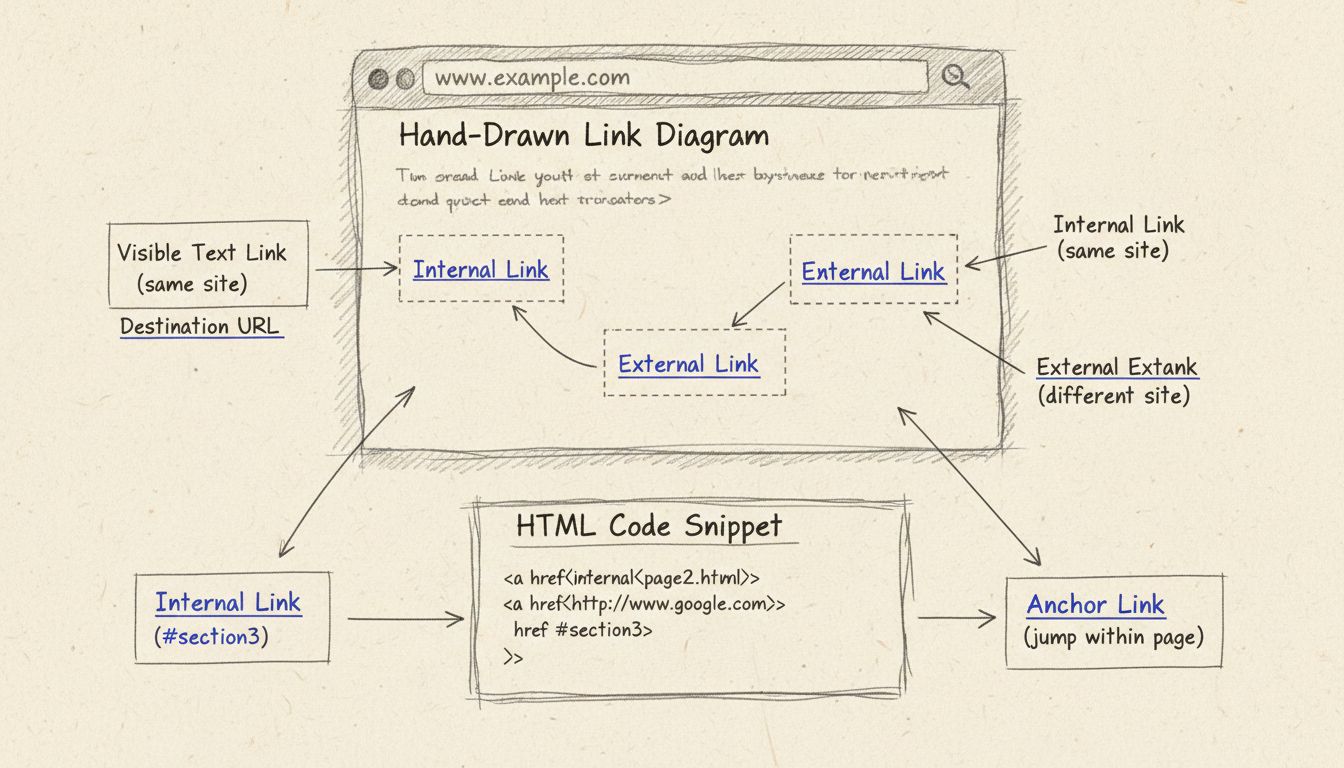
Anchor text is the visible, clickable text in a hyperlink. It is the part of a link that a user sees and can click — typically appearing in a different color (often blue) and underlined — to navigate from one webpage to another. In HTML, the words placed between the opening <a> tag and closing </a> tag form the anchor text.
For example, in this link to a guide on affiliate marketing strategies , the phrase “affiliate marketing strategies” is the anchor text. The underlying HTML looks like this:
<a href="https://example.com/affiliate-marketing-strategies/">affiliate marketing strategies</a>

Set up advanced tracking in minutes. No credit card required.
To a visitor browsing a webpage, anchor text stands out from surrounding content. Most modern browsers render it in a distinct color — commonly blue — with an underline. When a user hovers over it, the cursor changes to a pointer, and the destination URL often appears in the browser’s status bar.
Here is what the same link looks like to a reader versus in the source code:
<a href="https://example.com/seo-checklist/">complete SEO checklist</a>The anchor element (<a>) contains two essential parts: the href attribute, which holds the destination URL, and the anchor text between the tags. When no text is present — such as with an image link — search engines fall back to the image’s alt text to understand the link’s purpose. This makes alt text functionally equivalent to anchor text for image-based links.
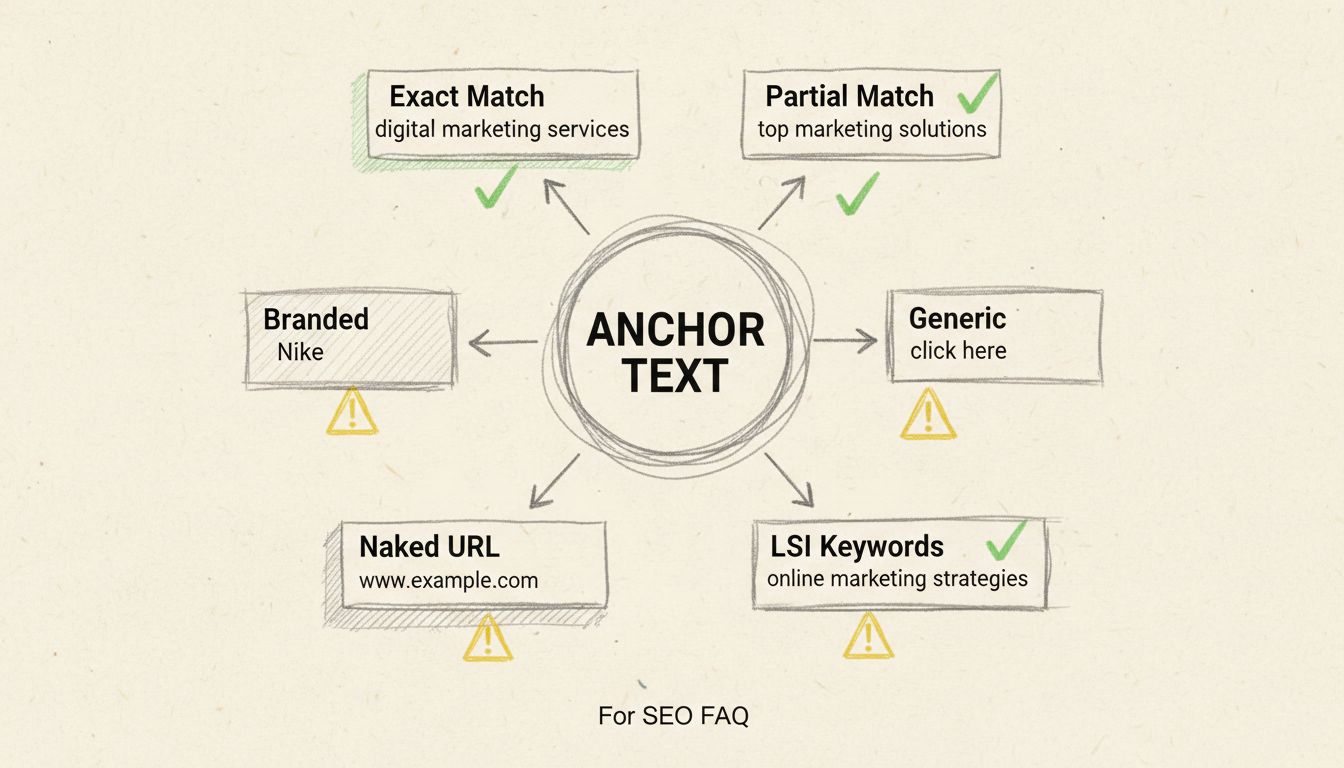
Anchor text is not one-size-fits-all. Search engines evaluate the diversity and natural distribution of anchor text types across your link profile. Using the same type repeatedly — especially exact-match keywords — looks manipulative and can trigger penalties. Below are the nine types recognized in modern SEO practice.
| Type | Description | Example |
|---|---|---|
| Exact-match | Uses the precise target keyword of the linked page. | anchor text linking to a page about anchor text |
| Partial-match | Includes a variation of the target keyword within a broader phrase. | anchor text optimization guide |
| Branded | Uses a brand, company, or website name. | — |
| Naked URL | The raw URL displayed as the link text. | https://example.com |
| Generic | Non-descriptive phrases that do not indicate the topic. | click here, read more, learn more |
| Image anchor | An image serving as the link; the alt text acts as the anchor. | A product photo with alt text blue running shoes |
| Brand + keyword | Combines a brand name with a descriptive keyword. | — |
| LSI / related | Uses semantically related terms rather than the exact keyword. | link text optimization for a page about anchor text |
| Zero / empty | A link with no visible text and no alt attribute. | <a href="/page"></a> |
Generic anchors like “click here” are not inherently harmful but provide zero SEO value. Naked URLs are acceptable for citations and references but should not dominate.
Be the first to know about new features and product updates.
When Google crawls a page, it follows links and reads their anchor text to infer what the destination page covers. Descriptive anchor text acts as a contextual signal. If multiple external pages link to your article about “affiliate tracking software” using variations of that phrase, Google becomes more confident that your page is relevant for that topic. This directly influences rankings.
Links transfer ranking power — often called link equity or “link juice” — from one page to another. The anchor text surrounding that equity shapes how search engines weight the relevance of the transferred value.
Internal links with clear anchor text help search engines crawl and index your site efficiently. They establish a hierarchy: pages linked with descriptive anchor text from multiple internal sources signal greater importance within your site architecture. This is especially relevant for large sites with hundreds or thousands of pages, such as affiliate program directories or ecommerce catalogs.
Users scan pages quickly. Clear, descriptive anchor text tells them in a fraction of a second whether a link is worth clicking. Generic phrases like “click here” force the reader to read surrounding context to understand the destination — adding friction and reducing click-through rates. This behavioral signal indirectly feeds into SEO through engagement metrics.
Anchor text spam refers to the deliberate manipulation of link text to game search rankings. The most common tactic — historically — was building large volumes of backlinks using exact-match anchor text for high-value keywords. Post-Penguin, it became a liability.
Google’s algorithms now analyze anchor text distribution across a site’s entire backlink profile. Red flags include:
When detected, Google may apply a manual action or algorithmic suppression, causing ranking drops that can take months to recover from.
Anchor text manipulation at scale is obsolete. What works now is:
Best practices have shifted from keyword-focused optimization to user-centered relevance. Below are the current standards, distilled from Google’s guidelines and cross-referenced with competitive analysis of top-ranking pages.
Good anchor text tells the reader exactly what to expect. Avoid vague phrases.
affiliate commission structures explainedclick here for more information about how commissions work in affiliate programsThe anchor text must accurately describe the destination page. Mismatched anchor text — where the words promise one topic but the page delivers another — frustrates users and erodes trust. This is sometimes called the “bait and switch” and is explicitly discouraged by Google.
A natural link profile mixes branded, partial-match, generic, naked URLs, and occasional exact-match anchors. Aim for a distribution that looks organic rather than engineered.
Write anchor text that flows naturally within the surrounding sentence. The words before and after the link — the link context — matter nearly as much as the anchor text itself. Search engines read the full paragraph, not just the linked words, when interpreting relevance.
Anchor text should be immediately recognizable as a link. Standard conventions — underlined text in a contrasting color — help users identify clickable elements without hunting. Styling links to blend with body text reduces click-through and harms accessibility.
When every other word is a hyperlink, readers cannot distinguish what matters. Limit links per paragraph to one or two, and ensure each serves a clear purpose. This applies to both internal links and external links.
Analyzing your anchor text profile is essential for diagnosing SEO issues and spotting spam before it triggers a penalty. There are several methods, ranging from free manual checks to dedicated SEO platforms.
For small sites, you can view the source code of any page (right-click → “View Page Source” in most browsers) and search for <a href= to examine link elements and their anchor text. Browser extensions like the Web Developer Toolbar can highlight all links on a page, making manual audits faster.
Dedicated tools provide anchor text reports across your entire backlink profile:
When reviewing an anchor text report, watch for:
Anchor text plays a practical role at every level of affiliate marketing — from the publisher writing product reviews to the program manager enforcing brand guidelines.
When you link to a merchant’s product page, the anchor text you choose affects both click-through rates and SEO.
Practical workflow:
Sony A7 IV review rather than click herecheck the latest price on Amazon instead of buy nowMerchants running affiliate programs should monitor how affiliates use anchor text when linking to their products. Unauthorized use of trademarked brand names in anchor text — or misleading anchors that misrepresent the product — can dilute brand equity and confuse customers.
Practical workflow:
Program managers sit between advertisers and publishers. Anchor text policies should balance the advertiser’s brand protection needs with the publisher’s need for authentic, natural-sounding content.
Practical workflow:
Anchor text is a ranking signal — one of hundreds. Optimizing it alone will not rescue a page with thin content, poor site architecture, or no backlinks. Similarly, anchor text cannot fix a broken user experience. Its value is cumulative and contextual: good anchor text across many links reinforces relevance over time; isolated optimization produces negligible results.
| Term | Definition |
|---|---|
| Anchor text | The visible, clickable text in a hyperlink that describes the linked page |
| Exact-match anchor | Anchor text that precisely matches the target keyword of the destination page |
| Partial-match anchor | Anchor text containing a variation of the target keyword |
| Branded anchor | Anchor text using a brand or company name |
| Naked URL | The full URL displayed as the link text |
| Generic anchor | Non-descriptive phrases like “click here” or “read more” |
| Link equity | The ranking value passed from one page to another through links |
| Hyperlink | The complete clickable element — including URL, tags, and anchor text |
| Alt text | Image description text that substitutes for anchor text in image links |
For advertisers, publishers, and affiliate program managers, anchor text is a small element with outsized impact. Well-chosen anchor text improves navigation, strengthens SEO, protects brand integrity, and increases the likelihood that a reader follows your link to its destination.
Discover how using diverse and relevant anchor text can boost your website's visibility, improve user engagement, and drive organic traffic.
Learn what visible text links are, how they work, and why they matter for SEO and user experience. Discover best practices for creating effective anchor text in...
Learn how anchor text impacts SEO rankings, user experience, and link building. Discover best practices for optimizing anchor text to improve your website's sea...
A text link is a single line of text containing a link to a website. Upon clicking on a text link the user is redirected to a different page.
Join our community of happy clients and provide excellent customer support with Post Affiliate Pro.




Cookie Consent
We use cookies to enhance your browsing experience and analyze our traffic. See our privacy policy.