


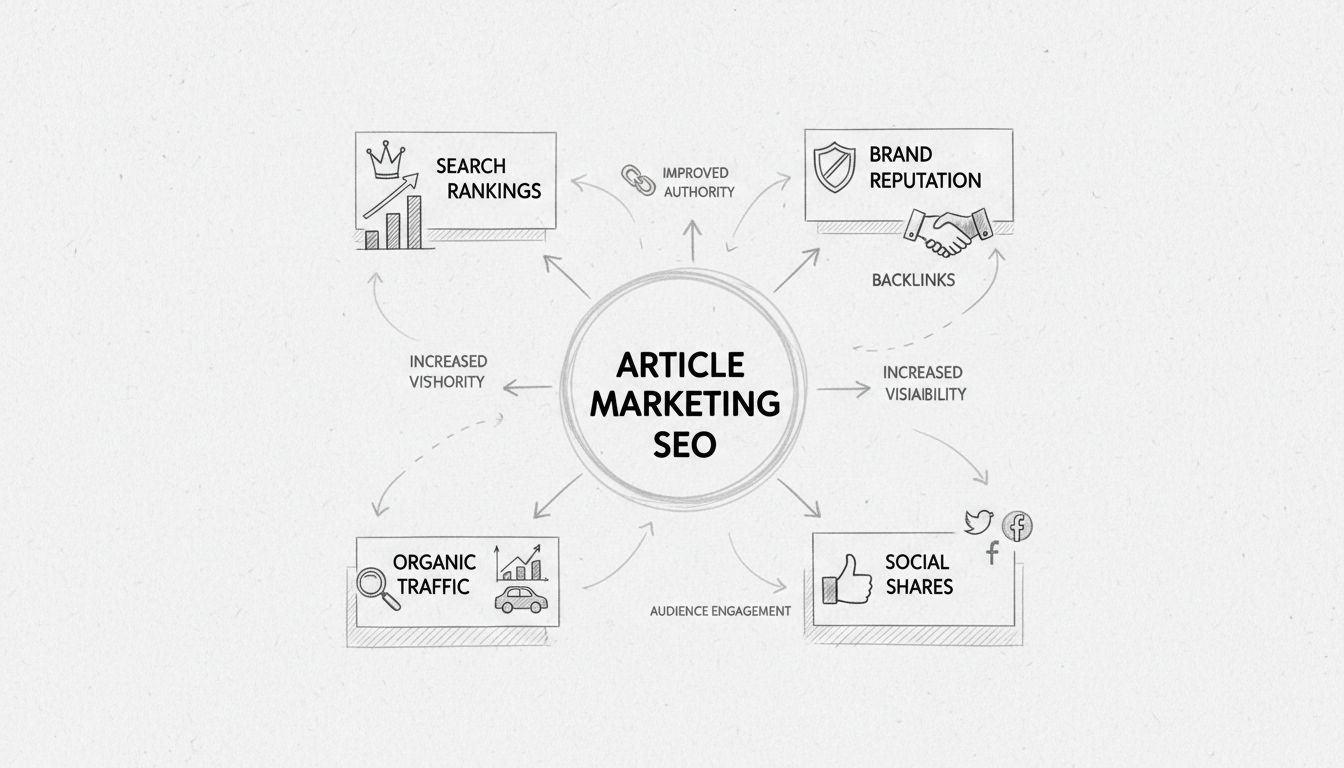
How Does Article Marketing Help SEO?
Discover how article marketing boosts SEO through backlinks, brand authority, and organic traffic. Learn proven strategies to improve search rankings with PostA...
10 min read
Article marketing is a content-driven digital marketing strategy in which a business or individual writes, publishes, and distributes informative articles to attract a target audience, establish authority, earn search engine rankings, and ultimately drive qualified traffic to a website or offer.
Article marketing is a content-driven digital marketing strategy in which a business or individual writes, publishes, and distributes informative articles to attract a target audience, establish authority, earn search engine rankings, and ultimately drive qualified traffic to a website or offer. Rather than pushing a direct sales message, article marketing educates readers and solves their problems — earning trust before asking for a click, a sign-up, or a purchase.
On this page
At its simplest, article marketing means writing and placing articles where your audience already spends time — on your own blog, on industry publications, on platforms like Medium or LinkedIn, or as guest posts on complementary websites. Each article addresses a specific question, problem, or topic that matters to your target audience, and it includes a natural, contextual connection back to your business.
The term gained traction in the early 2000s when marketers flooded article directories like EzineArticles with short, keyword-stuffed posts solely to generate backlinks. That version of article marketing is dead — and has been for over a decade.
Modern article marketing looks entirely different. It prioritizes:
Content marketing is the broader umbrella. It includes blog posts, videos, podcasts, social media content, email newsletters, webinars, white papers, and infographics.
| Aspect | Article Marketing | General Content Marketing |
|---|---|---|
| Primary format | Long-form written articles | Articles, video, audio, social, email |
| Primary goal | SEO rankings, referral traffic, authority | Brand awareness, engagement, conversions |
| Distribution | Owned blog, guest posts, industry sites | All channels including paid |
| Measurement | Organic traffic, backlinks, rankings | Multi-touch attribution across channels |

Set up advanced tracking in minutes. No credit card required.
Article marketing solves several persistent problems that businesses face when trying to grow online.
A well-optimized article can rank in Google for years. Unlike a paid ad that stops delivering the moment the budget runs out, an article that earns a top-three position for a relevant keyword generates traffic month after month.
When potential customers encounter your brand through a helpful article — not an ad — their perception shifts. You become a resource, not a vendor. This is especially important for B2B companies and affiliate program managers recruiting partners: publishers and affiliates want to work with brands that understand their space and can demonstrate expertise.
One strong article can be repurposed into social media posts, newsletter content, podcast talking points, and sales enablement material. It becomes a reusable asset. For affiliate program managers, a definitive guide to “how to earn with our program” serves as both a recruitment tool and an onboarding resource for new affiliates.
Articles that earn backlinks pass authority to your domain. Articles that rank for informational queries create entry points for users who may later convert on a product or sign-up page. This is the “rising tide lifts all boats” effect of strategic article publishing.
The mechanism is straightforward, but execution requires discipline. Here is the workflow we use when commissioning articles for our own marketing and the campaigns we recommend to our software users.
Before writing a single word, define who you are writing for and what problem they need solved. An affiliate program manager targeting publishers might ask: What questions do potential affiliates ask before joining a program? Common answers include commission structure comparisons, cookie-duration explanations, and platform reviews.
Market research at this stage typically involves mining People Also Ask boxes in Google, reviewing competitor content gaps, and talking to your existing customers or partners about what information they wish they had found earlier.
Keyword research for article marketing should prioritize search intent over raw search volume. A keyword with 200 monthly searches and clear informational intent often converts better — in terms of email sign-ups, affiliate applications, or demo requests — than a 5,000-volume term with vague intent.
Target a primary keyword (the main topic), 5–10 secondary keywords (related subtopics), and a set of LSI terms that signal topical depth to search engines.
This is where most article marketing efforts succeed or fail. The article must be:
On-page SEO for article marketing includes:
Publication is not the finish line — it is the starting point. Distribution channels include:
For affiliate program managers, distribution also means sharing articles in partner portals, affiliate newsletters, and recruitment outreach emails.
Track organic traffic, keyword rankings, backlinks earned, and conversion events (sign-ups, demo requests, affiliate applications) attributable to each article. Revisit and refresh articles every 12–18 months to maintain rankings — updating statistics, adding new sections, and improving readability based on performance data.
A high-performing article should be repurposed into additional formats: a video summary, an infographic, a slide deck, or a series of social media posts. This multiplies the return on the original investment and reaches audience segments that prefer different content formats.
Be the first to know about new features and product updates.
For companies using affiliate software, this often means writing distinct articles for merchants evaluating platforms, affiliates looking for program recommendations, and agencies managing multiple programs.
Publishing sporadically undermines article marketing results. A consistent schedule — whether weekly, biweekly, or monthly — signals to search engines that your site is active and gives your audience a reason to return. Based on data from our own content program, domains publishing 12 or more quality articles per quarter see meaningfully faster domain-authority growth than those publishing fewer.
Articles published only on your own blog reach only the audience you already have. Guest posting, syndication on industry platforms, and strategic placement on high-domain-authority sites expand your reach and earn backlinks that improve your own site’s SEO.
Without tracking, article marketing becomes a guessing game. At minimum, monitor organic sessions per article, average time on page, conversion rate, and backlinks earned. Use that data to double down on topics and formats that perform and to retire or rewrite underperformers.
Branding and article marketing reinforce each other. Every article you publish shapes how readers perceive your company — its expertise, its values, and its voice. Consistent article marketing over 12–24 months builds a brand identity that competitors cannot easily replicate.
For affiliate-focused companies, branding through articles helps attract higher-quality partners. Affiliates research programs before joining; when they find in-depth, transparent content from a brand, they are more likely to apply and to promote that brand with confidence.
Article marketing serves three distinct audiences in the affiliate ecosystem.
Publishing articles that explain your affiliate program — commission structures, cookie windows, promotional tools, success stories — attracts qualified affiliates and reduces the support burden. When a prospective affiliate can read a comprehensive guide before applying, their first interaction with your team is more informed and productive.
Article marketing is how many successful affiliates build their audience. A content-site affiliate might publish product comparison articles, how-to guides, and review posts that include affiliate links. The key is disclosure and genuine value: articles that help readers make informed decisions earn trust and generate sustainable affiliate revenue.
Program managers use article marketing to recruit, educate, and retain affiliates. Recruitment articles target potential partners searching for programs in a niche. Educational articles help existing affiliates improve their promotion strategies. Retention-focused content — such as case studies and success spotlights — keeps partners engaged and motivated.
Article marketing is not a quick win. It requires patience, writing skill or budget, and a realistic timeline.
There are also risks when article marketing is done poorly:
| Obsolete Practice (Pre-2012) | Current Best Practice (2026) |
|---|---|
| Submitting keyword-stuffed articles to directories | Publishing original, researched articles on reputable sites |
| Writing for search engines first | Writing for readers first; optimizing for search second |
| Measuring success by article count | Measuring success by organic traffic, engagement, and conversions |
| Spinning one article into dozens of variations | Repurposing one strong article into multiple formats (video, social, email) |
| Using exact-match anchor text in every backlink | Using natural, contextual anchor text and branded links |
If your article marketing approach still involves article directories, automated spinning tools, or keyword-density targets, it is time to reset. Google’s systems have evolved far beyond what those tactics can manipulate, and attempting them now carries more downside risk than upside potential.
Discover how article marketing can drive traffic, improve SEO, and grow your business. Leverage modern strategies and AI tools today.
Discover how article marketing boosts SEO through backlinks, brand authority, and organic traffic. Learn proven strategies to improve search rankings with PostA...

Content marketing can be a great way to build an online following that trusts your opinion, which could lead to increased sales for the products you promote.

Learn how to write engaging affiliate marketing content that ranks to draw your audience to your products/services.
Join our community of happy clients and provide excellent customer support with Post Affiliate Pro.




Cookie Consent
We use cookies to enhance your browsing experience and analyze our traffic. See our privacy policy.