


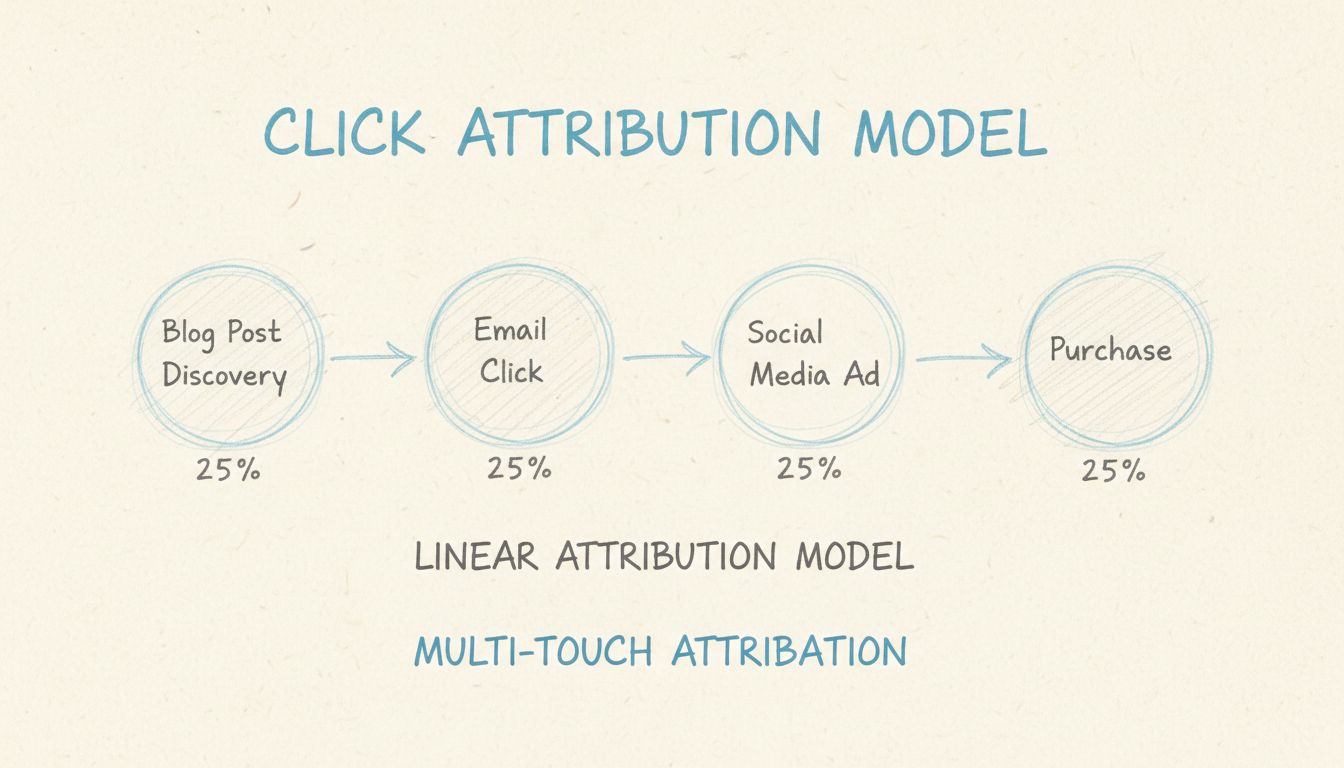
What is Click Attribution in Affiliate Marketing?
Learn what click attribution is in affiliate marketing, how different attribution models work, and why accurate tracking matters for your affiliate program succ...
10 min read
Attribution tracking in affiliate marketing is the systematic process of identifying which affiliate partner, marketing touchpoint, or promotional channel drove a customer to complete a desired action — such as a purchase, sign-up, or app install — and assigning the correct credit and commission to that source.
Attribution tracking in affiliate marketing is the systematic process of identifying which affiliate partner, marketing touchpoint, or promotional channel drove a customer to complete a desired action — such as a purchase, sign-up, or app install — and assigning the correct credit and commission to that source. It answers a deceptively simple question: who really earned this sale?
Without it, affiliate programs operate on guesswork. The affiliate who wrote a detailed product review three weeks ago might receive nothing, while the coupon site that appeared in the final search gets the full commission. Attribution tracking replaces that guesswork with rules, data, and transparency.
On this page
These two terms are often used interchangeably, but they describe distinct stages of the same pipeline.
Think of it as a courtroom analogy: tracking gathers the evidence (click IDs, timestamps, conversion values). Attribution is the judge who applies the rules and declares the winner.
This distinction matters because you can have flawless tracking and still produce unfair attribution if your model is wrong. Many affiliate programs running on last-click attribution collect perfect data yet systematically underpay the content partners who introduced the customer in the first place.

Set up advanced tracking in minutes. No credit card required.
The mechanics of attribution tracking follow a repeatable five-step workflow. Understanding each step helps program managers diagnose problems when commissions go to the wrong partner.
An affiliate publishes a unique tracking link — typically containing an affiliate ID, a campaign parameter, and sometimes a sub-ID for granular reporting. When a visitor clicks that link, the system generates a unique click ID and logs the event.
The click ID can be stored in two ways:
The user completes the target action — a purchase, a form submission, a trial sign-up, or an app install. The advertiser’s system fires a conversion pixel or a postback URL to notify the tracking platform.
The platform checks all stored click data within the active attribution window and applies the chosen model. If the program uses last-click attribution, the most recent affiliate touchpoint wins.
The attribution decision is logged in dashboards. Affiliates see credited conversions, program managers review performance, and commissions are calculated for payout. This data also feeds optimization decisions — which partners to scale, which to renegotiate, and which to sunset.
| Step | What Happens | Key Technology |
|---|---|---|
| User clicks affiliate link; unique click ID generated | Affiliate link with UTM/sub-ID parameters |
| Click data saved for later matching | Browser cookie or S2S postback |
| User completes purchase, sign-up, or install | Conversion pixel or postback URL |
| System applies model to assign credit | Attribution engine (last-click, multi-touch, etc.) |
| Dashboards update; commissions calculated | Affiliate software or network platform |
An attribution model is the rule set that decides how conversion credit is distributed. The model you choose shapes partner behavior, program costs, and which affiliates stay active. No single model fits every program.
How it works: A customer clicks Affiliate A’s blog review, then Affiliate B’s comparison page, then Affiliate C’s discount link and buys. Affiliate C gets the full commission. Affiliates A and B get nothing.
Advantages:
Drawbacks:
First-click attribution gives full credit to the first affiliate touchpoint in the customer journey.
How it works: Using the same journey — Affiliate A (blog review) → Affiliate B (comparison) → Affiliate C (discount code) → Purchase — Affiliate A receives the entire commission.
Advantages:
Drawbacks:
First-click works best for programs prioritizing brand awareness, market entry, or long consideration cycles where the initial introduction carries the most value.
Multi-touch attribution splits conversion credit across multiple affiliate touchpoints based on their measured contribution to the sale.
Common multi-touch variants include:
Advantages:
Drawbacks:
Position-based (U-shaped) attribution is a pragmatic middle ground. It acknowledges that the first introduction and the final nudge both carry outsized importance, while still recognizing middle-touch contributions.
This structure keeps discovery partners motivated while still rewarding closers.
Be the first to know about new features and product updates.
Affiliate attribution is fundamentally different from attributing paid search, social, or display advertising — and treating it the same way creates expensive mistakes.
In paid search, you bid on a keyword and Google delivers the ad. The relationship is transactional and anonymous. In affiliate marketing, you work with real publishers who decide how much effort to invest in your brand based on whether they feel fairly treated. When an attribution model consistently shortchanges content partners, those partners stop promoting you — and they rarely announce their departure.
It is common for multiple affiliates to influence the same sale. A customer might read a niche blog review, watch a YouTube comparison, and then search for a coupon code — all within the same purchase journey. Paid channels rarely overlap in this way because you control budget allocation centrally. In affiliate programs, overlap is the norm, not the exception.
When you adjust attribution weights, you are not just changing a dashboard number — you are redirecting real commission payments from one partner to another. This creates a zero-sum dynamic that paid media attribution does not have. A model change that benefits content affiliates necessarily reduces payouts to last-click partners, and vice versa.
Accurate attribution is not a technical nicety — it is the operational foundation of a healthy affiliate program. When attribution works, three things happen.
Affiliates who invest in detailed reviews, tutorials, and comparison content receive credit proportional to the value they create. This fairness keeps high-quality partners engaged and actively promoting your brand. When attribution is broken, those partners leave — and they are the hardest to replace.
Knowing which affiliates and partner types drive conversions at each stage of the funnel lets program managers allocate commissions, bonuses, and co-op budgets to the highest-impact relationships. Without this visibility, budgets flow to the partners who appear in last-click reports, not necessarily those who generate demand.
A clearly documented attribution policy — including the model, the attribution window, and how overlapping clicks are resolved — eliminates the most common source of affiliate frustration. Partners who understand the rules are more likely to trust the system, even when they do not win every conversion.
Attribution tracking is not a set-it-and-forget-it system. Several persistent challenges require ongoing attention from program managers.
A customer clicks an affiliate link on their phone during the morning commute, researches on a work laptop at lunch, and purchases on a tablet in the evening. Cookie-based tracking sees three separate sessions from three different devices — not one journey. The affiliate who started it all may receive no credit because the final conversion happened on a different device where no cookie existed.
S2S tracking and identity-resolution techniques help bridge this gap, but no solution is perfect. Cross-device attribution remains one of the hardest problems in performance marketing.
Third-party cookies have been deprecated or severely restricted in Safari, Firefox, and increasingly in Chrome. Intelligent Tracking Prevention (ITP) on Safari caps cookie lifetimes. These changes directly impact cookie-based affiliate tracking by shortening effective attribution windows and blocking cross-site tracking entirely in some scenarios.
The industry response has been a shift toward first-party cookies, server-side postbacks, and direct API integrations that do not rely on browser storage at all.
Under last-click attribution, coupon and cashback sites consistently capture credit on conversions that were actually driven by earlier content partners. A customer reads a detailed review, decides to buy, and then searches “[brand] coupon code” before checkout. The coupon site — which contributed nothing to the purchase decision — gets the full commission.
Programs can mitigate this by shortening the attribution window for coupon partners, using multi-touch models, or creating separate commission structures for different partner types.
When affiliate attribution operates in isolation from other marketing channels, the same conversion can be claimed by both the affiliate program and the paid search team. This double-counting inflates reported performance and leads to overspending. Unified attribution — where affiliate touchpoints are measured alongside paid, organic, and email channels — provides a truer picture of what drives revenue.
Choosing an attribution model is a strategic decision, not a technical checkbox. The right model depends on your partner mix, your customer journey length, and your growth priorities.
Short purchase cycles (under 24 hours, single-session purchases) are less affected by model choice because fewer touchpoints are involved. Long consideration cycles (weeks or months, multiple research sessions) make model choice critical — first-click and last-click diverge dramatically when journeys stretch across many touchpoints.
Data-driven attribution requires sufficient conversion volume and clean tracking infrastructure to produce statistically reliable weights. Programs with fewer than 500 conversions per month should start with a rules-based multi-touch model (such as position-based) and graduate to algorithmic models as data volume grows.
Influencer partnerships typically drive awareness and consideration rather than last-click conversions. A follower watches a product review, researches the brand independently, and purchases days later — often without clicking the influencer’s link at checkout. First-click or position-based attribution rewards the influencer for introducing the customer, which aligns incentives with the actual value delivered. Last-click attribution consistently undercounts influencer impact.
An attribution window (also called a lookback window or cookie window) defines how long after a click an affiliate remains eligible for credit if a conversion occurs. This setting is separate from the attribution model but equally important.
The window should reflect your actual purchase cycle. If your average customer takes 14 days from first research to purchase, a 7-day window will unfairly exclude affiliates who introduced customers early in the journey. If your product is an impulse buy (under $50, purchased within hours), a 30-day window may over-credit affiliates for organic or direct traffic that would have converted anyway.
A practical approach: analyze your own conversion data to find the median and 90th-percentile time from first affiliate click to purchase.
A common question from program managers running lean operations: can Google Analytics or a general analytics tool handle affiliate attribution instead of dedicated affiliate software?
The short answer is no — and here is why.
General analytics tools lack commission logic. Google Analytics can show you which channels drove conversions, but it cannot calculate tiered commissions, manage partner-specific rates, or generate payout reports. Attribution in analytics is informational; in affiliate software, it is transactional — it determines who gets paid.
Cookie limitations. Analytics platforms rely on the same browser-based tracking that is increasingly restricted. Dedicated affiliate platforms supplement cookie tracking with S2S postbacks, direct API integrations, and fallback mechanisms that general analytics tools do not provide.
Partner management. Affiliate platforms include partner portals, creative management, compliance monitoring, and payment processing. These are operational requirements, not analytics features.
Use analytics alongside your affiliate platform — not instead of it. Analytics tells you what happened across all channels. The affiliate platform tells you which partner earned the commission and automates the payout.
Attribution tracking makes this pattern visible and actionable.
When you can see which affiliates generate the majority of conversions, you can:
The flip side: if your attribution model is broken, your 80/20 analysis will be wrong. You may be over-investing in last-click partners who appear dominant in reports while under-investing in content partners whose contribution is invisible under your current model.
AI tools — including large language models like ChatGPT — are increasingly used in affiliate marketing, but their role in attribution is indirect and should be understood clearly.
AI cannot replace the tracking infrastructure itself. It cannot drop cookies, fire postbacks, or assign commissions. Attribution tracking remains a function of purpose-built affiliate software and networks. AI augments analysis and content creation; it does not replace the pipes that connect clicks to commissions.
Moving from default last-click attribution to a model that reflects real partner value requires a structured approach.
Before changing anything, document how your program currently attributes conversions. What model are you using? What is the attribution window? How are overlapping clicks resolved? Which partner types are winning and which are churning?
Categorize your affiliates by the stage they influence:
If your current model rewards only closers, your introducers and influencers are subsidizing your program with unpaid labor — and they will eventually stop.
Run a shadow attribution model alongside your current one for at least 30 days. Compare how commissions would have been distributed under the new model versus the old. Share the findings with key partners before making the switch. A transparent transition preserves trust.
When you change attribution models, some partners will earn more and some will earn less. Communicate the rationale, the data behind the decision, and the timeline before the change takes effect. Partners who understand why the change is happening are far more likely to stay than those who discover it on their commission statement.
Unlock the power of attribution tracking in affiliate marketing. Learn how to optimize campaigns, maximize ROI, and reward top-performing affiliates.
Learn what click attribution is in affiliate marketing, how different attribution models work, and why accurate tracking matters for your affiliate program succ...
Learn how affiliate tracking software records referrals, attributes conversions, calculates commissions, and supports program reporting and payouts.
Compare affiliate tracking methods, including cookies, pixels, postbacks, and coupon codes, with attribution examples and practical integration checks.
Join our community of happy clients and provide excellent customer support with Post Affiliate Pro.




Cookie Consent
We use cookies to enhance your browsing experience and analyze our traffic. See our privacy policy.