What Is a Direct Buy in Advertising?
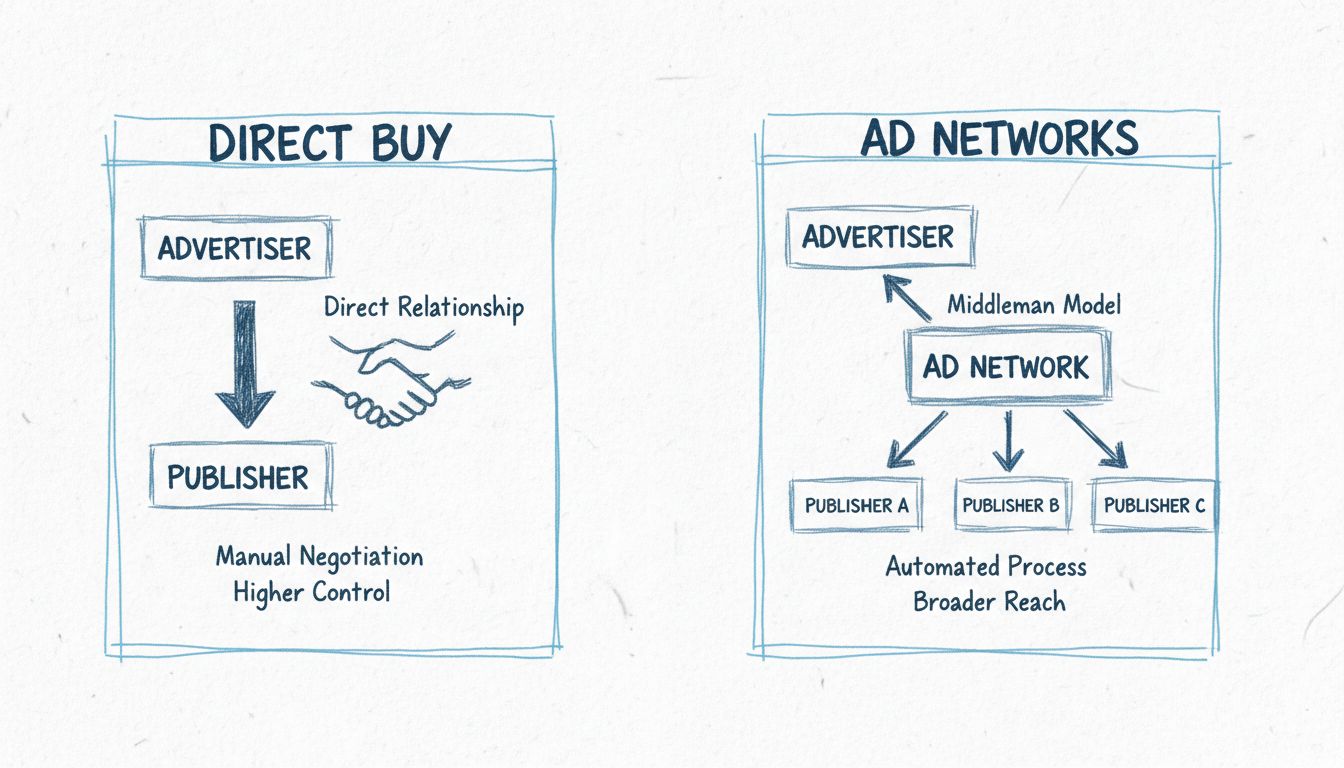
A direct buy is the traditional method of purchasing advertising space. An advertiser — or their media buying agency — contacts a publisher’s sales team, negotiates rates and placement terms, and signs a binding contract called an insertion order.
Unlike programmatic advertising, where algorithms bid on individual impressions in real time across thousands of sites, a direct buy locks inventory on one publisher’s property. The advertiser knows the site context before a penny is spent. The publisher knows the buyer and the price.
This model predates the internet. Print publications, radio stations, and television networks have sold ad space this way for decades. In digital advertising, the same principle applies — but the inventory now includes website banners, in-app placements, streaming audio slots, CTV ad breaks, digital billboards, newsletter sponsorships, and podcast reads.
What Is the Difference Between Direct and Indirect Advertising?
Direct advertising means the advertiser negotiates and buys placement from the media owner — no middle layer. Indirect advertising routes the purchase through an intermediary: an ad network, an agency trading desk, an ad exchange, or a demand-side platform (DSP). In an indirect model, the advertiser may not know exactly which sites carry the ad until post-campaign reporting. Direct buys offer transparency and control; indirect buys offer reach and automation.
What Is an Example of Direct Advertising?
A software company wants to sponsor a weekly industry newsletter with 80,000 subscribers. That is a direct buy.
Launch your affiliate program today
Set up advanced tracking in minutes. No credit card required.
How Does a Direct Buy Work?
A direct buy moves through four stages. Each produces a paper trail — the RFP, the IO, the trafficking sheet, and the final performance report.
1. Request for Proposal (RFP)
The buyer sends an RFP to one or more publishers. The brief includes campaign goals, target audience demographics, flight dates, budget range, and required ad formats (display ads, native content, video pre-roll, etc.). Publishers typically respond within three to five business days with a media plan that names placements, projected impressions, CPMs, and any custom unit pricing.
2. Insertion Order (IO)
Once the buyer selects a plan, both parties sign the insertion order. The IO is the binding contract. It specifies price, flight dates, impression goals, placement details, creative specs, and cancellation terms. Most US deals reference the IAB and 4A’s Standard Terms and Conditions for Internet Advertising, version 3.0, as the legal baseline.
3. Ad Trafficking
The publisher’s ad operations team receives the creative assets and implements the campaign. If the advertiser uses a third-party ad server, the publisher places ad tags on the agreed pages or placements. A third-party ad server is a web platform that stores creative, serves ads, and tracks delivery independently of the publisher’s own system. It gives the buyer a neutral source of truth for impression counting and viewability measurement — a critical tool when large direct media buying budgets are at stake.
4. Reporting and Reconciliation
After the campaign ends, the publisher delivers a final report — impressions served, clicks, viewability rates, and any agreed engagement metrics. The advertiser reconciles publisher numbers against their own ad server data.
What Is the Difference Between Direct and Programmatic Advertising?
The two models solve fundamentally different problems. Programmatic advertising prioritizes scale, speed, and audience data.
| Dimension | Direct Buy | Programmatic Advertising |
|---|
| Buying method | Negotiated insertion order | Real-time auction via DSP |
| Inventory | One publisher, named placements | Thousands of sites across exchanges |
| Pricing | Fixed CPM, locked upfront | Variable — first-price or second-price auction |
| Targeting basis | Site context, publisher first-party data | Audience signals, behavioral data, retargeting |
| Setup time | Days to weeks | Minutes to hours |
| Minimum spend | — | No minimum on most DSPs |
| Reporting | Publisher report plus advertiser ad server | Unified DSP dashboard |
| Best for | Brand sponsorships, premium context, custom units | Scale campaigns, performance marketing, retargeting |
Direct Buying vs. Real-Time Bidding (RTB)
In a direct buy, the advertiser and publisher agree on terms before the campaign starts. In real-time bidding — the most common form of programmatic buying — an auction happens in the milliseconds between a user loading a webpage and the ad rendering. Multiple advertisers bid for that single impression, and the highest bidder wins. RTB operates at massive scale: a campaign can touch millions of impressions across thousands of sites. But the advertiser has limited control over where each individual ad appears, which is why brand-safety concerns persist in open-auction programmatic.
What Is Programmatic Guaranteed?
The DSP and SSP automate delivery and reporting, but no auction occurs. PG combines the certainty of a direct buy with the efficiency of automated ad serving. It is part of the broader category called programmatic direct, which also includes private marketplaces (PMPs): invitation-only auctions where selected buyers bid on premium inventory from a single publisher or curated group of publishers.
Join our newsletter
Be the first to know about new features and product updates.
When Should You Use Direct Buying vs. Programmatic Buying?
The decision depends on campaign objectives, budget, timeline, and how much control the advertiser needs over placement context.
Choose Direct Buying When
- Brand safety is non-negotiable — for example, a financial services firm advertising on a trusted news site’s markets section.
- The campaign requires custom creative formats a DSP cannot serve: expandable units, interactive rich media, or sponsored content integrations.
- You are building a long-term publisher relationship for recurring sponsorships.
- You want fixed pricing to lock in a media budget without auction volatility.
Choose Programmatic Buying When
- You need to reach a large, dispersed audience quickly across multiple sites and formats.
- Campaign performance depends on audience signals — demographics, browsing behavior, retargeting, lookalike modeling.
- You want real-time optimization: pausing underperforming placements, shifting budget to top-converting audiences, or A/B testing creative mid-flight.
- Your minimum spend is modest — DSPs accept campaigns in the hundreds of dollars, not tens of thousands.
Using Both Together
A brand might run a direct buy for a homepage sponsorship on a key industry site while a programmatic campaign retargets visitors who clicked but didn’t convert. Direct delivers the high-impact, brand-building moments; programmatic fills the volume and performance layer underneath.
What Are the Advantages and Limitations of Direct Buys?
Advantages
No algorithmic surprises.
- Premium inventory access. Publishers reserve their best positions — homepage takeovers, above-the-fold placements, dedicated email sends — for direct buyers who pay a fixed premium CPM.
- Custom integrations. Direct deals enable formats programmatic pipes cannot handle: sponsored articles, co-branded content hubs, interactive rich-media units, podcast host-read ads.
- Predictable costs. Fixed CPMs or flat fees make media budget forecasting straightforward. There is no auction-driven price volatility.
- Direct publisher relationships. Long-term partnerships can yield better rates, first access to new inventory, and collaborative campaign ideation.
Limitations
- Time-intensive. RFPs, negotiations, IO revisions, and manual trafficking add days or weeks to campaign setup. A direct buy cannot launch in an afternoon.
- Limited scale. One publisher means one audience. Reaching comparable scale to a programmatic campaign across thousands of sites requires multiple direct deals, each with its own negotiation cycle.
- Less audience targeting sophistication. Direct buys target context and publisher first-party data, not the behavioral and cross-device signals available through programmatic platforms.
- Manual reporting burden. Reconciling publisher reports against ad server data, negotiating makegoods, and aggregating results across multiple direct deals takes labor that programmatic dashboards handle automatically.
What Does a Direct Buy Look Like?
Modern direct ad campaigns have evolved beyond banner placements on a single site. Here are three examples that reflect current practice.
What Does a Direct Buy Look Like in 2026?
A B2B SaaS company targets engineering leaders. The advertiser provides the creative and a UTM-tracked landing page URL. The publisher inserts the ad into the newsletter template and reports open-rate and click-through data weekly. No DSP, no auction — a pure direct buy.
Example 2: CTV Direct with a Streaming Publisher
The insertion order specifies the content adjacency rules — no competitor ads within the same ad pod — and the creative rotation sequence. The publisher’s ad server manages delivery; the advertiser’s third-party ad server provides independent verification.
Example 3: Direct OOH with Digital and Print Mix
A retail brand runs a market-saturation campaign using direct outdoor buys: 40 static billboards and 25 digital OOH screens across three cities, negotiated through the media owner’s sales team over four weeks. The deal includes custom pricing for longer commitment, premium arterial-road placements, and integrated reporting across print and digital inventory.
Why Modern Direct Ad Campaigns Are Different
Direct buying is no longer defined by faxed insertion orders and phone calls alone. The negotiation is manual, but the infrastructure is increasingly automated — a pragmatic blend that preserves placement control without sacrificing operational efficiency.