


What is a Good Domain Authority? Complete Guide to DA Scores
Learn what constitutes a good domain authority score, how it impacts SEO rankings, and strategies to improve your website's DA for better search visibility.
8 min read
Domain Authority is Moz’s estimate of how well a domain will perform in organic search.
On this page
Domain Authority is Moz’s estimate of how well a domain will perform in organic search. It was introduced as a way to move beyond single-metric evaluations — like counting backlinks — and offer a composite score that reflects the overall strength of a website’s link profile.
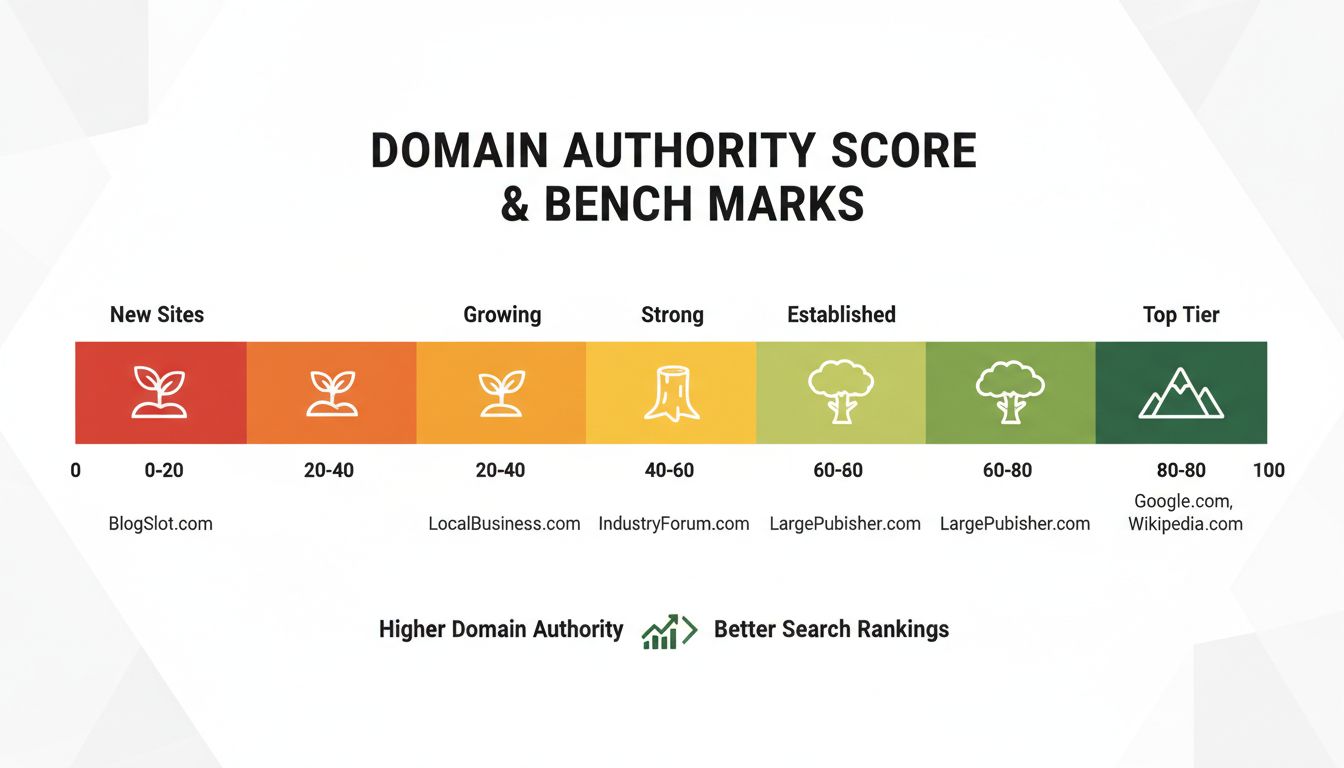
The score runs from 1 to 100 and is logarithmic: moving from 10 to 20 is far easier than moving from 70 to 80. This design mirrors real-world ranking dynamics, where competing in highly competitive SERPs demands exponentially more authority.
DA is relative, not absolute. A score of 40 might be excellent for a local bakery but weak for a national insurance comparison site. The metric only becomes meaningful when compared against sites targeting the same keywords and audience.
While Domain Authority measures the strength of an entire domain, Page Authority (PA) scores a single URL. Both are Moz metrics on a 1–100 logarithmic scale, and both rely heavily on backlink signals. A blog post that earns thousands of editorial links can have a PA far higher than the domain’s overall DA — and can rank well even on a lower-authority site.
Different SEO platforms use different names for conceptually similar metrics. Each is calculated differently, so scores do not translate one-to-one across tools.
| Metric | Platform | Scale | Primary Input |
|---|---|---|---|
| Domain Authority (DA) | Moz | 1–100 | Link profile (40+ factors, machine-learned) |
| Domain Rating (DR) | Ahrefs | 0–100 | Quantity and quality of referring domains |
| Authority Score (AS) | Semrush | 0–100 | Backlink quality, organic traffic, spam signals |
| Trust Flow | Majestic | 0–100 | Quality of backlinks weighted by trusted seed sites |
Using two or more of these metrics together gives a fuller picture. If your DA is 45 but your DR is 30, investigate the discrepancy — it often points to differences in how the tools weigh link quality versus link volume.

Set up advanced tracking in minutes. No credit card required.
Moz calculates DA using a machine-learning model trained on actual SERP results. The model compares the link profiles of thousands of domains against their observed ranking positions and identifies which factors best predict ranking performance.
While the full list of factors is proprietary, Moz has confirmed that the calculation weighs over 40 signals. The most influential include:
Because DA is trained against real ranking data, Moz periodically updates the algorithm — most recently with DA 2.0. When the algorithm changes, your DA may shift even if your backlink profile hasn’t changed. This is normal and is covered in more detail below.
A DA fluctuation does not always mean your site improved or declined. Common causes include:
The best response to a DA drop is to check whether your organic traffic and rankings have actually changed. If they haven’t, the DA movement is likely a measurement artifact, not a real problem.
No. Google does not use Domain Authority — or any third-party authority metric — in its ranking algorithms. Google’s John Mueller has stated this repeatedly, and Google’s own documentation confirms that the search engine evaluates pages on hundreds of granular signals, not a single composite score.
However, DA correlates with ranking performance because it measures many of the same underlying signals Google uses: the quality and quantity of inbound links, domain-level trust indicators, and content strength. A site with a DA of 80 tends to rank better than a site with a DA of 20 — not because Google reads the DA number, but because the high-DA site almost certainly has a stronger backlink profile, more referring domains, and better overall SEO health.
Be the first to know about new features and product updates.
There is no universal “good” DA. What counts as strong depends entirely on your competitive landscape.
| Competitive Context | Typical DA Range | What “Good” Looks Like |
|---|---|---|
| Local business (single location) | 15–30 | 25+ is competitive |
| Regional or niche ecommerce | 25–45 | 40+ is strong |
| National B2B / SaaS | 40–60 | 55+ competes with leaders |
| High-competition publishing (news, finance, health) | 50–80+ | 70+ needed for top SERPs |
If your DA is 35 and competitors average 50, the gap signals a need to invest in link building and content quality. If your DA is 35 and competitors average 30, your link profile is already competitive — focus on content depth and on-page optimization instead.
A DA of 20 is typical for a new or small website with a modest backlink profile. For a local business or a niche blog, 20 can be perfectly adequate to rank for low-competition keywords. For a national brand, 20 is below competitive range. The score itself is neutral — its adequacy depends on who you’re competing against.
DA is important not because it directly affects rankings, but because it serves as a leading indicator of your site’s competitive position. It helps you:
Several free and paid tools provide authority metrics. The right choice depends on how many domains you need to check and how deeply you need to analyze the data.
For regular monitoring, pick one primary tool and check monthly. Authority metrics move slowly; weekly checks add noise without insight.
Improving DA is a byproduct of improving your site’s overall SEO health — particularly its backlink profile. There is no shortcut. Tactics that promise quick DA gains (link farms, paid link schemes, mass directory submissions) are likely to backfire by inflating your spam score.
The single most effective way to raise DA is to earn links from domains that themselves have high authority.
Other sites link to data they can cite.
Internal links distribute page-level authority across your domain. A well-structured internal linking architecture helps search engines understand which pages are most important and ensures link equity flows to key pages. Use descriptive anchor text, link deep (not just to your homepage), and audit for orphan pages that receive no internal links.
Not all links help. Links from spammy, irrelevant, or penalized sites can raise your spam score and suppress DA. Use Moz’s Spam Score tool, Ahrefs, or Semrush to identify toxic links. For links you cannot get removed manually, use Google’s Disavow Tool — but only as a last resort and only for clearly harmful links. Over-disavowing can hurt more than it helps.
While DA is primarily a link-based metric, the underlying signals it models correlate with user experience. A fast, mobile-friendly, well-structured site earns more links, retains visitors longer, and sends positive engagement signals. Ensure your site loads quickly, has clear navigation, uses HTTPS, and avoids intrusive interstitials.
One viral post isn’t enough. Sustainable DA growth comes from consistently publishing content that solves real problems for your audience. When every piece of content is worth referencing, backlinks accumulate naturally over time — and DA follows.
DA works best as a directional compass, not a daily dashboard metric. Here is a practical workflow for affiliate program managers, advertisers, and publishers:
DA has meaningful blind spots that every practitioner should understand:
Several once-common DA tactics are now counterproductive:
Discover strategies and tools to increase your domain authority, improve search rankings, and grow your affiliate marketing results.
Learn what constitutes a good domain authority score, how it impacts SEO rankings, and strategies to improve your website's DA for better search visibility.
Page Authority (PA) is a Moz metric (1–100) predicting how well a webpage ranks in search results.

Learn what constitutes a good Page Authority score in 2025. Discover benchmarks, how PA impacts rankings, and strategies to improve your page's authority with P...
Join our community of happy clients and provide excellent customer support with Post Affiliate Pro.



Cookie Consent
We use cookies to enhance your browsing experience and analyze our traffic. See our privacy policy.