


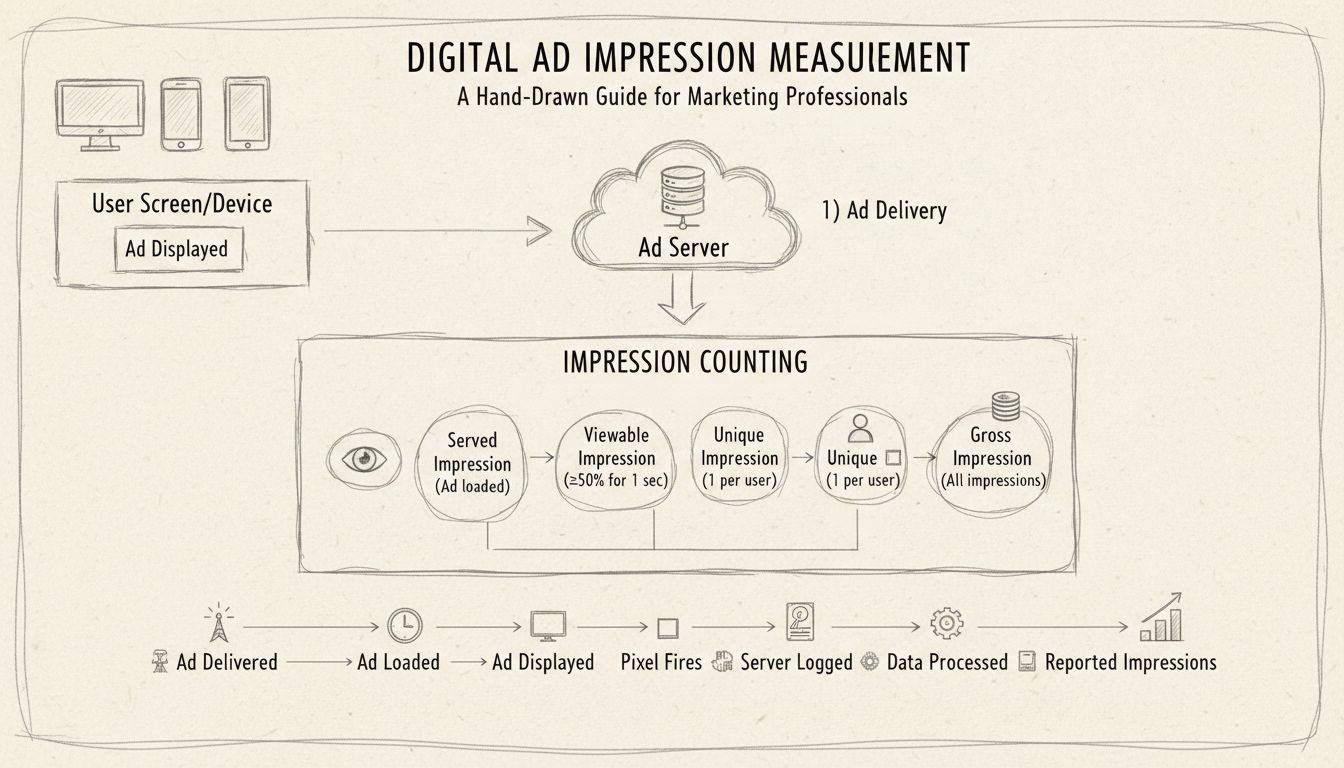
How Are Impressions Measured in Digital Advertising?
Learn how impressions are measured in digital advertising. Understand served, viewable, unique, and gross impressions. Discover measurement methods, industry st...
12 min read
An impression in marketing is a single instance of an advertisement, social media post, search result listing, or other digital content appearing on a user’s screen.
On this page
An impression in marketing is a single instance of an advertisement, social media post, search result listing, or other digital content appearing on a user’s screen. The moment a display ad loads on a webpage, a sponsored post renders in a feed, or a page link shows up in Google Search results, one impression is recorded.
The definition is precise in one respect: an impression measures potential exposure, not confirmed attention. A user does not need to look at the content, scroll to it, click it, or even have their browser tab active. If the content loaded, it counts.
This distinction matters. Google defines an impression in its advertising documentation as each time an ad is shown on a search results page or another site in the Google Network. Facebook counts one impression every time a post or ad enters a user’s screen. Neither platform requires interaction. In every case, the impression is counted at the moment of display — nothing more.
The term “impression” originally moved into digital media from traditional advertising, where print publishers estimated the number of readers who might see a magazine ad or the number of drivers passing a billboard. Those were rough estimates. Digital impressions are counted precisely through server logs, ad tags, and tracking pixels, making the metric far more quantitative than its offline predecessor.

Set up advanced tracking in minutes. No credit card required.
Not all impressions are measured the same way. The industry uses two standards, and knowing the difference changes how you read campaign data.
A served impression is counted the moment an ad server delivers content to a page, regardless of where on the page the ad appears or whether the user ever scrolls to it. This was the dominant standard through the early 2010s and is still used in some programmatic contexts.
The problem with served impressions is straightforward: an ad delivered 3,000 pixels below the fold and never scrolled to still counts. This is why the industry shifted.
The practical difference is significant. When you buy on a viewable CPM, you pay only for impressions that meet the MRC threshold. When you buy on a served basis, you are paying for every ad delivery, viewable or not. Most major platforms — Google Ads, Meta, The Trade Desk — now default to viewable measurement.
Impression measurement depends on the channel.
| Channel | How Impressions Are Counted | Key Platform Example |
|---|---|---|
| Display ads | Ad tag fires when creative loads; viewable measurement uses browser geometry API | Google Display Network |
| Search ads | Counted each time an ad appears on a SERP, even if below the fold | Google Ads, Microsoft Advertising |
| Social media | Counted when a post or ad enters a user’s viewport | Meta Ads Manager, LinkedIn |
| Google Search Console | Counted each time a URL appears in search results, regardless of rank or clicks | Google Search Console |
| Video (YouTube) | Counted when the video thumbnail is shown; viewable = 50% visible for 2 seconds | YouTube Ads |
| Email marketing | Counted when the tracking pixel loads; not always reliable due to image blocking | Most ESP platforms |
| Affiliate banners | Counted when the banner creative loads on the publisher’s page | — |
In Google Search Console, an impression is counted every time a link to your site appears in Google Search results — even if it appears on page 9 and the user never scrolls to it. A single search query can generate multiple impressions if several pages from your domain rank for it. For example, if a user searches “best affiliate tracking software” and three pages from your site appear at positions 4, 7, and 12, that query generates 3 impressions. This is why Search Console impressions often look large but CTR can appear low; impressions count exposure in the index, not on an active screen.
Be the first to know about new features and product updates.
These three metrics are often confused. Here is the distinction:
| Metric | What It Measures | Example |
|---|---|---|
| Impressions | Total number of times content appears on screen | An ad is shown 10,000 times |
| Reach | Total number of unique users who saw the content at least once | Those 10,000 impressions reached 6,200 unique people |
| Clicks | Total number of times users clicked the content | 200 people clicked the ad |
If your campaign shows 10,000 impressions with a reach of 6,200, the average frequency is 1.6 — each unique user saw the ad roughly 1.6 times. If impressions were 27,000 with the same 6,200 reach, frequency jumps to 4.4.
Four impressions means your content appeared on a screen four times. If reach data shows those 4 impressions reached 1 unique user, that user saw your content 4 times. If reach is 4, four different users each saw it once. The number means nothing in isolation — you always need reach (or frequency) alongside it.
Twenty-seven impressions is a number you would typically see on a small or highly targeted campaign. If reach is 3, your frequency is 9 per user — a level that can cause ad fatigue on display and social channels. If 27 impressions came from 27 unique users (reach = 27, frequency = 1), you have broad but very light exposure. In retargeting campaigns, a frequency of 9–15 per user per month is common and often intentional; in prospecting campaigns, a frequency above 5 usually signals overly narrow targeting or insufficient budget.
CPM — cost per mille (thousand) impressions — is the pricing model for impressions-based advertising. Advertisers pay a set rate for every 1,000 times their ad is displayed.
| Channel | CPM Range | Notes |
|---|---|---|
| Programmatic display | — | Lower for remnant inventory; premium placements cost more |
| Social media (Meta) | — | Varies sharply by audience and objective |
| — | Highest CPMs; justified by B2B targeting precision | |
| Connected TV (CTV) | — | Premium video; strong viewability |
| YouTube (skippable) | — | You pay only when 30 seconds or the full ad is watched |
| Google Search (top of page) | Priced per click typically | Impressions are free; you pay per click in auction model |
CPM is the standard pricing model for brand awareness campaigns, where the goal is visibility rather than immediate response.
Whether that spend is justified depends on what happens after those impressions — the downstream CTR and conversion rate.
There is no universal “good” impression count. What counts as strong depends on audience size, channel, and objective:
High impressions without corresponding engagement can indicate wasted spend. But high impressions are a strong signal in these scenarios:
Impressions are not a vanity metric. They answer the first question every marketer asks: “Is anyone seeing this?”
Before someone can click, engage, or buy, they must first see your content. Impressions measure that step. Smaller impression volumes can still move the needle for niche B2B brands where the addressable audience is measured in thousands, not millions.
Every downstream performance metric depends on impressions as its denominator:
On social media platforms, impressions are among the most accessible metrics. Meta defines an impression as any time content enters a user’s screen; Twitter/X counts impressions when a post is served into a timeline or search result. LinkedIn measures impressions when a post appears in the feed.
Impression counting is not perfectly consistent across platforms. Discrepancies arise from several sources:
For affiliate program managers, impression fraud is a genuine risk with CPM-based publisher deals. A publisher reporting 1,000,000 monthly impressions that generate zero clicks warrants a closer look — install verification tags and cross-reference with your own analytics before renewing at scale.
Increasing impressions is a function of budget, targeting, and creative quality. Practical levers include:
Affiliate marketing programs use impressions in several specific ways.
Impressions on affiliate partner sites represent free brand exposure when the deal is structured on a CPA (cost per action) basis — you pay only when a sale occurs, but your brand still gets the visibility of every impression the publisher’s banner or link generates. This makes affiliate impressions some of the most cost-efficient visibility available.
A publisher’s impression volume is part of their pitch to advertisers. High-traffic sites attract premium affiliate programs and can negotiate better commission tiers. However, impressions alone do not close the deal — advertisers care about the quality of those impressions.
Monitoring impressions across affiliate placements helps identify two things: which partners have high-visibility inventory worth expanding into, and which partners may be generating impressions without delivering value (impression fraud or poorly placed creatives). A practical workflow: every quarter, pull a report of top-20 affiliates by impression volume and compare against their click and conversion data. Partners with high impressions and zero clicks after 90 days should be audited — the placement may be below the fold, on an unrelated page, or fraudulent.
Media impressions is a broader term encompassing all impressions across paid, earned, and owned channels. Unlike ad impressions — which are strictly paid — media impressions include:
The total number of media impressions across all three categories gives a complete picture of brand visibility. Most brands undercount earned impressions because they lack media monitoring tools. A PR placement on a major publication might generate 500,000 impressions — equivalent to $2,000–$4,000 in paid display at typical CPM rates — but those impressions only show up if you are tracking them.
Leverage advanced affiliate marketing tools to monitor, analyze, and optimize your ad impressions for maximum campaign success.
Learn how impressions are measured in digital advertising. Understand served, viewable, unique, and gross impressions. Discover measurement methods, industry st...
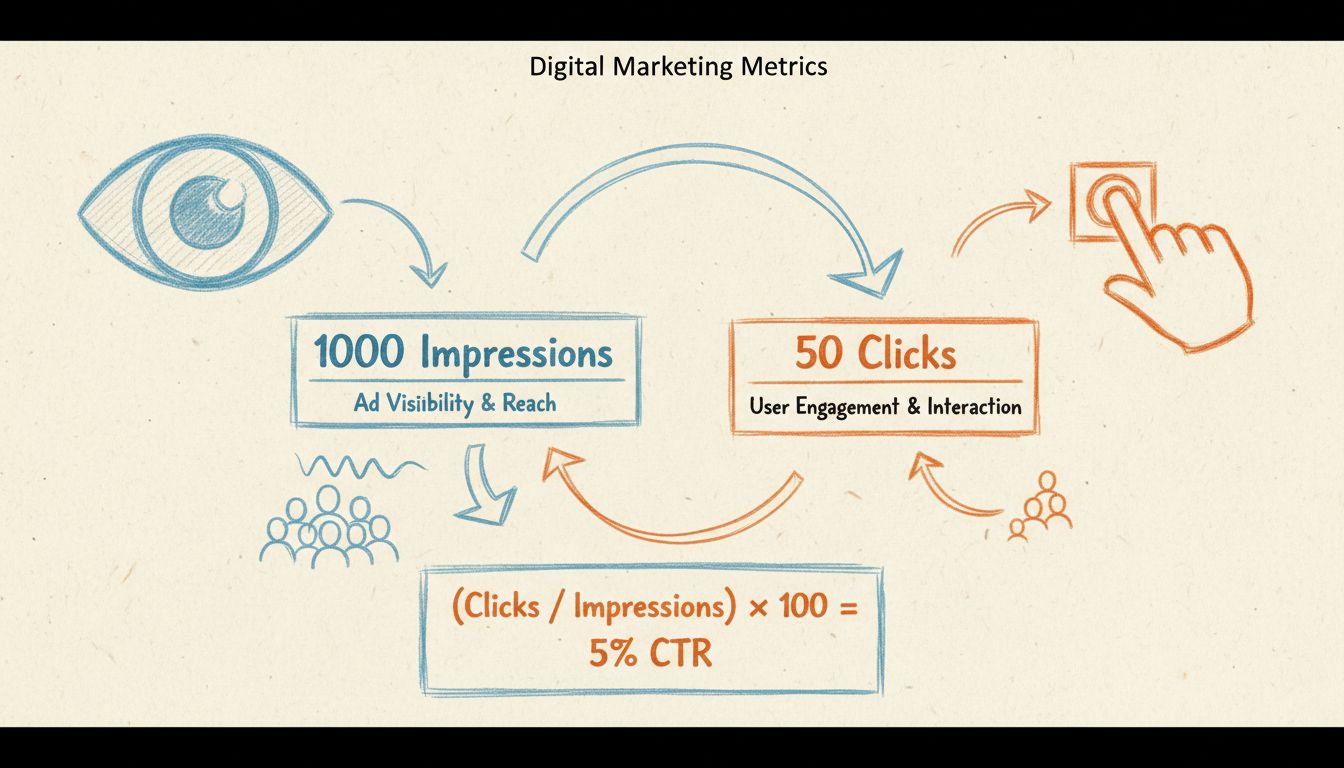
Learn the key differences between clicks and impressions in digital marketing. Understand how these metrics impact your affiliate marketing strategy and ROI wit...
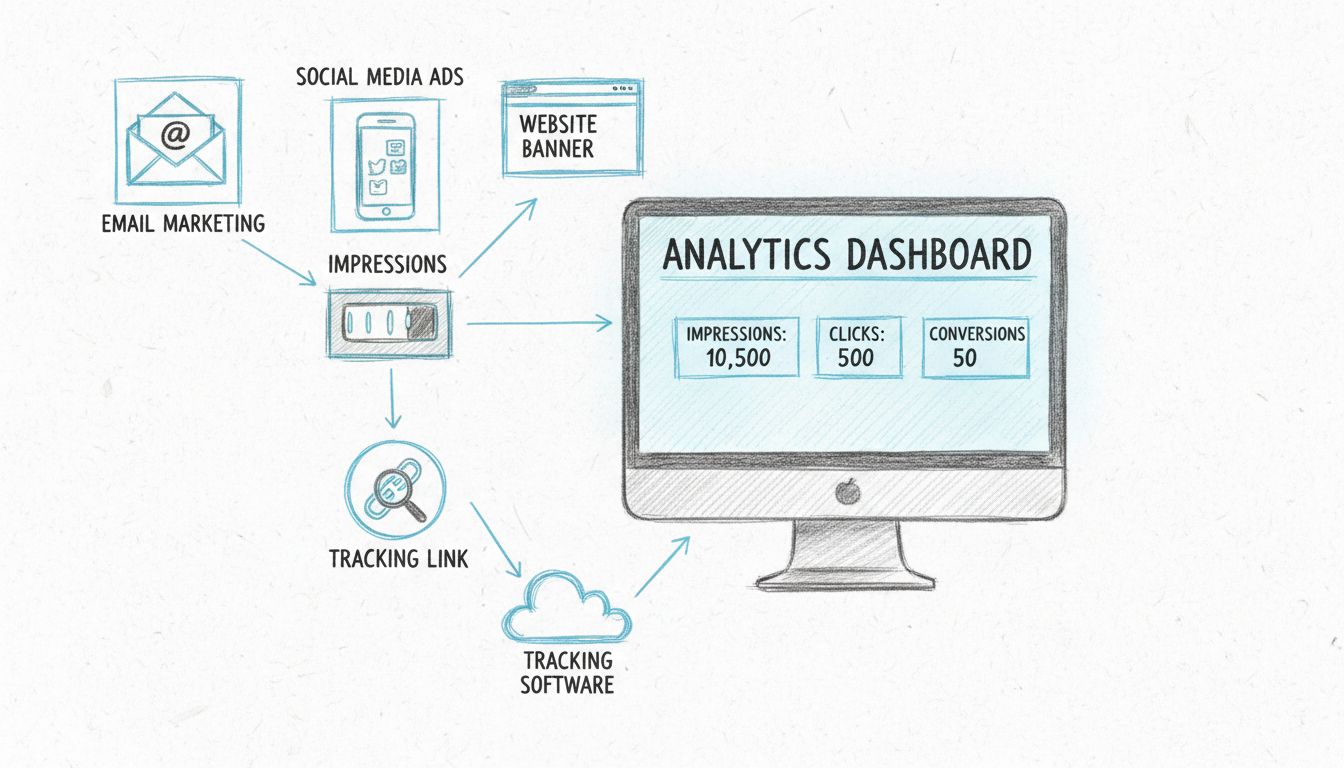
Learn how to track impressions effectively using affiliate tracking software, analytics tools, and multiple advertising channels. Master impression metrics for ...
Join our community of happy clients and provide excellent customer support with Post Affiliate Pro.



Cookie Consent
We use cookies to enhance your browsing experience and analyze our traffic. See our privacy policy.