


What is Link Building? Complete Guide to Backlinks & SEO Authority
Learn what link building is and why it's crucial for SEO. Discover proven strategies to acquire high-quality backlinks and improve your website's search ranking...
11 min read
A link building service is a professional SEO offering in which an agency, freelancer, or specialized firm helps a website earn hyperlinks (backlinks) from other websites.
A link building service is a professional SEO offering in which an agency, freelancer, or specialized firm helps a website earn hyperlinks (backlinks) from other websites. The goal is to improve the site’s authority, search engine rankings, and organic traffic. Rather than building links manually, the client outsources prospecting, outreach, content creation, and placement tracking to experts who do it full-time.
On this page
A link building service is the outsourced version of one of SEO’s hardest, most time-intensive activities: earning editorial backlinks from reputable, topically relevant websites.
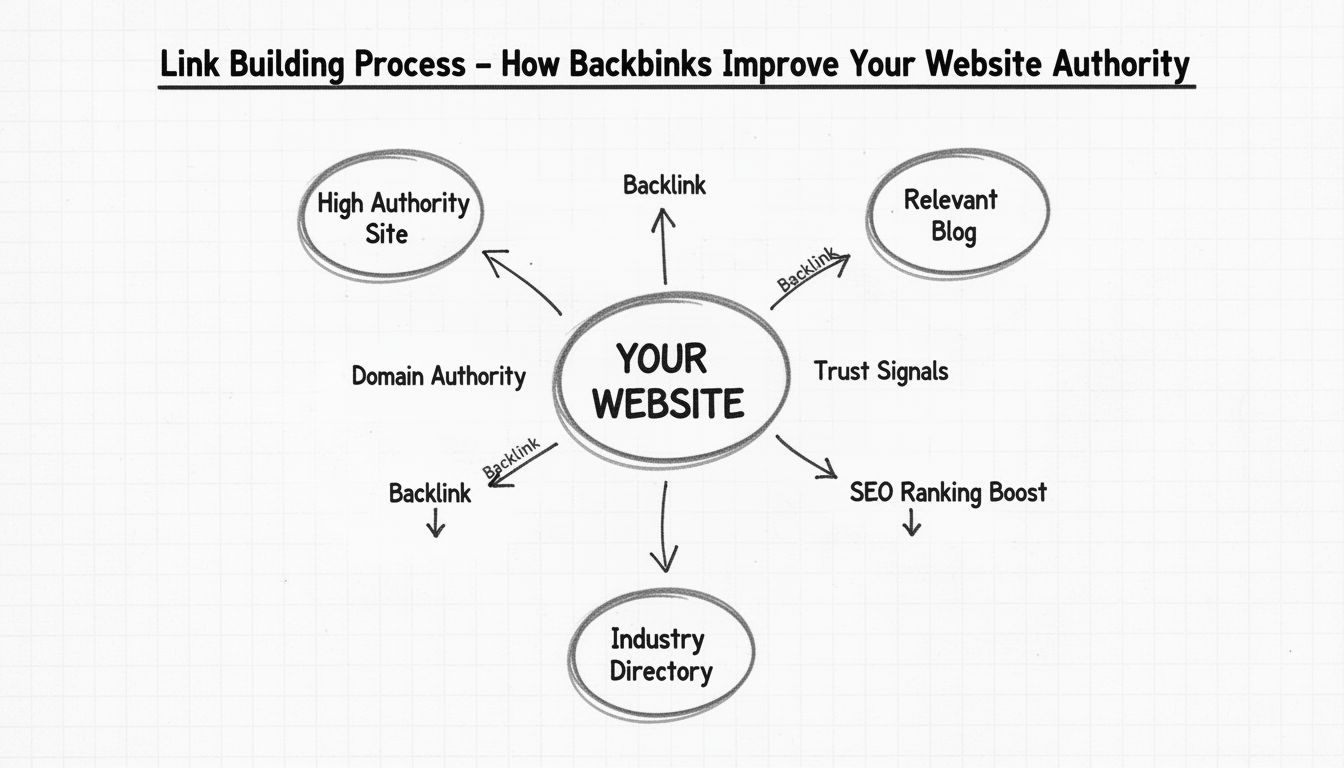
Search engines treat backlinks as votes of confidence. When a trusted site links to yours, it signals that your content has value. Over time, a strong backlink profile raises your domain authority and pushes your pages higher in search results. The problem is that earning those links requires prospecting thousands of sites, crafting personalized outreach, negotiating placements, writing guest content, and tracking everything that sticks — work most in-house teams can’t sustain.
That is what a link building service does for you. It replaces scattered, ad-hoc outreach with a managed program. The service provider brings existing relationships with editors and site owners, templates refined across hundreds of campaigns, and a team whose only job is to build links that move the needle.

Set up advanced tracking in minutes. No credit card required.
Most link building services follow a five-stage workflow that repeats monthly or quarterly:
Prospect research. The team identifies target websites in your niche — blogs, news outlets, resource pages, industry roundups — that have real organic traffic, relevant audiences, and domain authority worth pursuing. They filter out link farms, irrelevant sites, and domains with spam scores that would harm your profile.
Content and angle development. For each target, the service crafts a reason to link: a guest post, a data-driven study, a quote from your subject-matter expert, or an improved replacement for a broken resource. The content must be genuinely useful, not a thin excuse for a hyperlink.
Outreach. This is where services earn their fees. Personalized emails go to editors and site owners. Follow-ups happen on a schedule. Relationships compound: a service that has placed links for 50 previous clients has an inbox trust advantage that a solo operator cannot replicate.
Placement and negotiation. When a site agrees, the service handles editorial guidelines, anchor text choices, and linking-page context. Good services push for editorial links — links earned because the content merits them, placed naturally within the body of a relevant page.
Reporting and monitoring. Every month you receive a report showing links acquired, domains added, anchor text distribution, and estimated traffic value. Many services also monitor existing links for removal or nofollow changes.
| Tactic | How It Works | Time to Results | Best For |
|---|---|---|---|
| Digital PR | Pitch data stories, expert commentary, or news angles to journalists and publications | 6–12 weeks | Brand authority, high-DA links |
| Guest posting | Write original articles for industry blogs in exchange for an editorial backlink | 4–8 weeks | Niche authority, referral traffic |
| Broken link building | Find dead links on relevant sites and suggest your content as a replacement | 3–6 weeks | Quick wins, resource-page placements |
| Resource page link building | Get listed on curated “best tools” or “useful links” pages in your niche | 2–4 weeks | Steady, lower-difficulty links |
| Unlinked brand mentions | Find sites that reference your brand without linking and ask for the link | 1–3 weeks | Low-effort wins |
| Skyscraper technique | Identify content with many backlinks, create something better, and pitch it to the same sites | 8–12 weeks | Competitive keyword targeting |
| HARO / Qwoted / Connectively | Respond to journalist queries with expert quotes; links come from major media outlets | 4–8 weeks | High-authority editorial links |
Several link building tactics that worked a decade ago are now either worthless or actively harmful:
Tactics that scale easily — because they require no real editorial judgment — tend to be the ones Google devalues fastest.
Be the first to know about new features and product updates.
Link building service pricing varies dramatically based on domain authority targets, content requirements, and the provider’s existing relationships.
| Service Tier | Typical Cost | What You Get |
|---|---|---|
| Entry-level / marketplace | — | Links from DR 20–40 sites; less vetting; may include niche edits on existing posts |
| Mid-tier agency | — | Custom-written content, DR 40–60+ targets, manual outreach, monthly reporting |
| Premium / digital PR | — | Top-tier media links (DR 70+), original data studies, journalist relationships |
| Monthly retainer (full service) | — | 3–15+ links per month, strategy calls, competitor gap analysis, anchor text planning |
Most agencies require a minimum commitment of 3–6 months. Links take time to earn, and link building campaigns compound: the second quarter almost always outperforms the first.
The distinction between ethical and manipulative link building is the single most important factor in choosing a service because getting it wrong can wipe out years of SEO progress.
White hat link building follows Google’s Webmaster Guidelines. It earns links through merit: creating content worth referencing, building relationships with editors, and contributing to industry conversations. The links come from real sites with real audiences, and they would exist even if search engines did not.
Black hat link building manipulates rankings through paid link schemes, PBNs, automated link injection, comment spam, and other tactics designed to trick algorithms. These approaches can deliver short-term ranking lifts but carry severe risk: manual actions, algorithmic demotions, and in some cases complete de-indexing.
| White Hat | Black Hat |
|---|---|
| Digital PR and earned media mentions | Private Blog Networks (PBNs) |
| Resource page outreach with genuine value | Bulk link purchases from Fiverr or forums |
| Broken link replacement with better content | Automated link injection / hacked links |
| Relationship-based blogger outreach | Excessive reciprocal linking schemes |
Google’s link spam policy specifically calls out buying or selling links for ranking purposes, excessive link exchanges, and automated link creation as violations. Recovering from a manual action can take 6–12 months — far longer than building links properly the first time.
A well-linked affiliate program landing page ranks higher for terms like “best [niche] affiliate program” and “[product] affiliate program.” When your program page appears in search results, you recruit affiliates passively — without spending on ads or affiliate networks. Link building services help program managers build the domain authority that makes passive recruitment possible.
Additionally, many link building services can place your program on “best affiliate programs in [niche]” roundup posts, which drive qualified publishers directly to your sign-up page.
Advertisers benefit when their product pages, category pages, and blog content earn backlinks. Each link is a potential source of referral traffic — visitors who click through from the linking page. Unlike paid ads, referral traffic from editorial links compounds: the link stays live, the traffic keeps coming, and the SEO value accrues.
If you run affiliate recruitment campaigns, high-authority backlinks to your key landing pages also make your program more discoverable in search, which feeds your pipeline of new affiliates.
Affiliate publishers live and die by search rankings. A review site that ranks #1 for “[product] review” earns exponentially more affiliate commissions than one on page two. Link building services help publishers:
The build-vs-buy decision depends on resources, timeline, and existing expertise.
| Factor | DIY Link Building | Agency / Service |
|---|---|---|
| Time to first links | 3–6 months (learning curve) | 4–8 weeks |
| Success rate | Low initially; improves with relationships | High from day one |
| Control | Complete | Shared; depends on reporting quality |
| Scalability | Capped by your team’s bandwidth | Scales with budget |
| Risk of mistakes | High if inexperienced | Lower with reputable providers |
Evaluating link building services is harder than evaluating most other SEO services because link quality is not instantly visible in a dashboard. Here is a practical framework:
Ask for methodology, not just results. A credible service will describe exactly how they prospect, qualify targets, conduct outreach, and report. Vague answers are a red flag.
Request sample reports and anonymized case studies. Look for domain-level detail: which sites earned links, what their DR/DA was at the time, and whether traffic arrived after placement. Avoid services that only show aggregate counts.
Check third-party reviews independently. Search Reddit, Trustpilot, and SEO forums for unfiltered feedback. Pay particular attention to complaints about link removal rates — some services build links that disappear within weeks.
Verify that the service uses white hat tactics. Ask directly: “Do you use PBNs?” and “Do you pay for link placements?” A reputable provider will answer clearly and without hedging.
Start with a small test engagement. Commit to one month or a small placement package before signing a long-term contract. Judge the deliverables, not the pitch deck.
Understand what happens to the content. If the service creates guest posts or articles, clarify who owns the content and whether it remains live if you stop paying. Some services remove links when contracts end; others earn permanent placements.
Ask about communication cadence. Will you receive weekly updates or only monthly reports? Can you see the outreach pipeline in real time? Services that keep you informed about strategy shifts, target changes, and what is in the pipeline tend to be more accountable.
Discover proven link building services and strategies that help your website rank higher and gain more organic traffic.
Learn what link building is and why it's crucial for SEO. Discover proven strategies to acquire high-quality backlinks and improve your website's search ranking...
A backlink is a link from one website to another, signaling trust and authority to search engines.
A link farm is a network of websites built to manipulate search rankings through artificial linking. Learn the risks and how to stay safe.
Join our community of happy clients and provide excellent customer support with Post Affiliate Pro.




Cookie Consent
We use cookies to enhance your browsing experience and analyze our traffic. See our privacy policy.