


Content Farm
A content farm churns out low-quality SEO content at scale to earn ad revenue. Learn to spot one.
7 min read
ContentFarm
SEO
+3
Understanding what a link farm is matters for anyone who owns a website, runs an affiliate program, or buys backlinks.
Understanding what a link farm is matters for anyone who owns a website, runs an affiliate program, or buys backlinks. This article covers the definition, how search engines detect link farms, the consequences of participating in one, how to audit your own backlink profile, and what actually earns links today.
A link farm is any collection of websites that extensively hyperlink to one another with the primary goal of manipulating search rankings. The sites are typically low-quality, built from reused templates, and filled with thin or auto-generated content. Their outbound links point to other members of the network — or to external sites that paid for placement — creating an artificial web of mutual endorsement.
The term originated in the late 1990s, when search engines like Google relied heavily on PageRank, a system that treated each link as a vote of confidence. The more inbound links a page had, the higher it ranked. Webmasters quickly realized they could game the system by building networks of sites whose only function was to link to each other.
A legitimate website earns links because its content is useful, original, or newsworthy. A link farm earns links because someone paid for them or built a reciprocal arrangement. The differences are structural:
| Trait | Legitimate Website | Link Farm |
|---|---|---|
| Content quality | Original, researched, edited | Thin, spun, or AI-generated at scale |
| Author identity | Named experts with bios | Anonymous or fake profiles with stock photos |
| Outbound links | Selective, relevant, editorial | Excessive, often to unrelated industries |
| Organic traffic | Consistent, from diverse queries | Negligible; traffic comes from the farm itself |
| Design | Custom or thoughtfully themed | Recycled templates across dozens of domains |
| Domain TLD | Mix of .com, .org, country codes | Disproportionate use of cheap TLDs like .xyz, .top, .info |
| Publishing cadence | Steady, editorial | Bursts of posts when clients pay, then silence |
The terms are often used interchangeably, but they describe different structures:
| Feature | Link Farm | Private Blog Network (PBN) |
|---|---|---|
| Purpose | Mutual linking within the group; sometimes selling links | Passing link equity to one or more “money sites” outside the network |
| Content strategy | Minimal, often nonsensical | Often uses expired domains with residual authority; content may appear more legitimate |
| Link direction | All sites link to each other | Sites link outward to the target site; rarely link among themselves |
| Detection difficulty | Easier — obvious interlinking patterns | Harder — designed to look like independent sites |
| Google’s classification | Link scheme (spam) | Link scheme (spam) — both violate guidelines |
Both are considered black hat SEO and both carry the same risks: devaluation, manual action, or removal from Google’s index.

Set up advanced tracking in minutes. No credit card required.
In Google’s earliest algorithm, PageRank measured a page’s importance by counting how many other pages linked to it — and how important those linking pages were. A link from a high-PageRank site was worth more than one from an obscure page. This made links the dominant ranking signal for over a decade.
The formula was elegant but gameable. If links were currency, webmasters could print their own by building networks of interlinked sites. Early link farms were crude: pages with hundreds of unrelated links, no real content, and keyword-stuffed anchor text. They worked — for a while.
Google began targeting link farms with algorithmic updates as early as 2003. The Penguin update (2012) was the watershed moment: it demoted sites with manipulative link profiles at scale. Subsequent iterations made Penguin real-time and more granular.
Google’s spam policies explicitly prohibit “links that are intended to manipulate PageRank or a site’s ranking in Google search results.” The policy lists examples that describe link farms precisely:
rel="nofollow" or rel="sponsored" attributeAny site participating in these practices — as a link source or a link destination — is in violation.
The consequences of link farming fall into two categories:
Algorithmic devaluation: Google’s systems detect the pattern and simply stop counting the links. The site doesn’t get a notification — its rankings just slide. Traffic from search declines gradually, and recovery requires cleaning the backlink profile.
Manual actions: A human reviewer at Google applies a penalty to the site. The site owner receives a notice in Google Search Console under “Manual actions” with a description like “Unnatural links to your site.” Until the issue is resolved and a reconsideration request is submitted and approved, the site may rank poorly or not at all.
Link farming is not illegal in the criminal sense — no law prohibits building interlinked websites. It is, however, a violation of Google’s Webmaster Guidelines, which are contractual terms of using Google Search. The practical consequence is exclusion from the world’s largest search engine, which for most businesses is commercially fatal.
Certain aggressive forms of link farming that involve hacking sites to inject links, or that deceive consumers through fake endorsements, may cross into fraud or computer misuse laws. But the standard link farm — a network of low-quality sites selling links — is a terms-of-service violation, not a crime.
Be the first to know about new features and product updates.
Modern search engines analyze the link graph — the map of how sites connect to each other — at massive scale. Link farms produce patterns that are statistically distinct from organic linking:
Google’s SpamBrain, an AI-based spam-detection system, trains on these patterns and flags them automatically.
Link farm sites share visual and structural signatures:
A single site with one or two of these traits might be legitimate. A network where every site shares five or more is almost certainly a link farm.
If you run an affiliate program and recruit publishers, you need to screen for link farms. A publisher that participates in a link farm can:
Before approving a publisher, check their site against the 10-point checklist above. A publisher with no organic traffic, anonymous authors, and posts that exist only to host affiliate links is unlikely to generate real sales.
If you’re a content publisher monetizing with affiliate links, the fastest way to lose your rankings is to buy backlinks from a farm. The short-term ranking bump — if any — disappears the moment Google’s next update rolls out. The long-term damage to your domain’s trust can take years to repair.
Instead, invest in the content and relationships that earn links naturally. A single well-researched article that ranks on its own merits will outlast any number of farmed links.
Removing these publishers protects the program’s reputation and keeps reporting data clean. It also signals to Google that your brand is not associated with manipulative practices.
A link farm is any collection of websites that extensively hyperlink to one another with the primary goal of manipulating search rankings. The sites are typically low-quality, built from reused templates, and filled with thin or auto-generated content. Their outbound links point to other members of the network — or to external sites that paid for placement — creating an artificial web of mutual endorsement.
The term originated in the late 1990s, when search engines like Google relied heavily on PageRank, a system that treated each link as a vote of confidence. The more inbound links a page had, the higher it ranked. Webmasters quickly realized they could game the system by building networks of sites whose only function was to link to each other.
A legitimate website earns links because its content is useful, original, or newsworthy. A link farm earns links because someone paid for them or built a reciprocal arrangement. The differences are structural:
| Trait | Legitimate Website | Link Farm |
|---|---|---|
| Content quality | Original, researched, edited | Thin, spun, or AI-generated at scale |
| Author identity | Named experts with bios | Anonymous or fake profiles with stock photos |
| Outbound links | Selective, relevant, editorial | Excessive, often to unrelated industries |
| Organic traffic | Consistent, from diverse queries | Negligible; traffic comes from the farm itself |
| Design | Custom or thoughtfully themed | Recycled templates across dozens of domains |
| Domain TLD | Mix of .com, .org, country codes | Disproportionate use of cheap TLDs like .xyz, .top, .info |
| Publishing cadence | Steady, editorial | Bursts of posts when clients pay, then silence |
The terms are often used interchangeably, but they describe different structures:
| Feature | Link Farm | Private Blog Network (PBN) |
|---|---|---|
| Purpose | Mutual linking within the group; sometimes selling links | Passing link equity to one or more “money sites” outside the network |
| Content strategy | Minimal, often nonsensical | Often uses expired domains with residual authority; content may appear more legitimate |
| Link direction | All sites link to each other | Sites link outward to the target site; rarely link among themselves |
| Detection difficulty | Easier — obvious interlinking patterns | Harder — designed to look like independent sites |
| Google’s classification | Link scheme (spam) | Link scheme (spam) — both violate guidelines |
Both are considered black hat SEO and both carry the same risks: devaluation, manual action, or removal from Google’s index.
In Google’s earliest algorithm, PageRank measured a page’s importance by counting how many other pages linked to it — and how important those linking pages were. A link from a high-PageRank site was worth more than one from an obscure page. This made links the dominant ranking signal for over a decade.
The formula was elegant but gameable. If links were currency, webmasters could print their own by building networks of interlinked sites. Early link farms were crude: pages with hundreds of unrelated links, no real content, and keyword-stuffed anchor text. They worked — for a while.
Subsequent iterations made Penguin real-time and more granular.
Google’s spam policies explicitly prohibit “links that are intended to manipulate PageRank or a site’s ranking in Google search results.” The policy lists examples that describe link farms precisely:
rel="nofollow" or rel="sponsored" attributeAny site participating in these practices — as a link source or a link destination — is in violation.
The consequences of link farming fall into two categories:
Algorithmic devaluation: Google’s systems detect the pattern and simply stop counting the links. The site doesn’t get a notification — its rankings just slide. Traffic from search declines gradually, and recovery requires cleaning the backlink profile.
Manual actions: A human reviewer at Google applies a penalty to the site. The site owner receives a notice in Google Search Console under “Manual actions” with a description like “Unnatural links to your site.” Until the issue is resolved and a reconsideration request is submitted and approved, the site may rank poorly or not at all.
Both outcomes hurt. Recovery takes months.
Link farming is not illegal in the criminal sense — no law prohibits building interlinked websites. It is, however, a violation of Google’s Webmaster Guidelines, which are contractual terms of using Google Search. The practical consequence is exclusion from the world’s largest search engine, which for most businesses is commercially fatal.
Certain aggressive forms of link farming that involve hacking sites to inject links, or that deceive consumers through fake endorsements, may cross into fraud or computer misuse laws. But the standard link farm — a network of low-quality sites selling links — is a terms-of-service violation, not a crime.
Modern search engines analyze the link graph — the map of how sites connect to each other — at massive scale. Link farms produce patterns that are statistically distinct from organic linking:
Google’s SpamBrain, an AI-based spam-detection system, trains on these patterns and flags them automatically.
Link farm sites share visual and structural signatures:
A single site with one or two of these traits might be legitimate. A network where every site shares five or more is almost certainly a link farm.
Before accepting a link placement or buying a guest post, run this checklist. Three or more failures strongly suggest a link farm:
Start with Google Search Console. Navigate to Links > External links > Top linking sites. Export the full list. Sort by the number of links from each domain — a domain sending hundreds of links from low-quality pages is a red flag.
Supplement with a third-party backlink tool such as Ahrefs, Semrush, or Majestic. These tools assign quality scores to linking domains and can surface patterns that manual review misses: clusters of domains on the same IP range, domains with identical link profiles, or domains that lost all their traffic after a Google update.
A backlink is suspicious when:
Not every low-quality link is a link farm link. A random forum post linking to your site is low-quality but not manipulative. The concern is patterns: links that were clearly placed as part of a scheme.
Google’s official guidance has shifted. Since the Link Spam Update, Google claims it automatically neutralizes spammy links, and most sites do not need to use the disavow tool. John Mueller of Google has repeatedly stated that disavowing is only necessary when:
For most sites, especially those that have never engaged in link farming, the best approach is to ignore low-quality links that Google already ignores. Disavowing links you didn’t build can sometimes do more harm than good if you accidentally disavow legitimate ones.
If you do need to disavow, create a plain-text file listing the domains or URLs (one per line, with domain: prefix for whole domains) and upload it through Google’s Disavow Links tool in Search Console.
Recovery depends on what hit you:
Recovery timelines vary. Manual action reviews take days to weeks. Algorithmic recovery after cleaning a profile can take months, because you need to earn new, legitimate links to offset what was lost.
It includes:
The most durable links come from content that serves a purpose no other page serves. This includes:
A data study that reveals, for example, average affiliate commission rates by industry will earn more links in a month than a link farm could sell in a year — and those links will actually pass value.
Effective approaches include:
These methods are slower than buying links from a farm. They’re also permanent, penalty-proof, and compound over time.
Affiliate marketers operate in an industry where link farms have historically been common — some affiliate sites buy links to boost product-review rankings, and some link farms disguise themselves as “affiliate directories” or “coupon sites.”
The distinction matters: a genuine affiliate site that reviews products, discloses its affiliate relationships, and earns links through its content quality is legitimate. A site that exists only to host affiliate links and buys backlinks from a farm is not.
If you run an affiliate program and recruit publishers, you need to screen for link farms. A publisher that participates in a link farm can:
Before approving a publisher, check their site against the 10-point checklist above. A publisher with no organic traffic, anonymous authors, and posts that exist only to host affiliate links is unlikely to generate real sales.
If you’re a content publisher monetizing with affiliate links, the fastest way to lose your rankings is to buy backlinks from a farm. The short-term ranking bump — if any — disappears the moment Google’s next update rolls out. The long-term damage to your domain’s trust can take years to repair.
Instead, invest in the content and relationships that earn links naturally. A single well-researched article that ranks on its own merits will outlast any number of farmed links.
Red flags include:
Removing these publishers protects the program’s reputation and keeps reporting data clean. It also signals to Google that your brand is not associated with manipulative practices.
Discover proven, Google-compliant strategies to improve your website's search rankings without risking penalties.
A content farm churns out low-quality SEO content at scale to earn ad revenue. Learn to spot one.
Learn what a link building service does, how it earns quality backlinks, and what it costs.
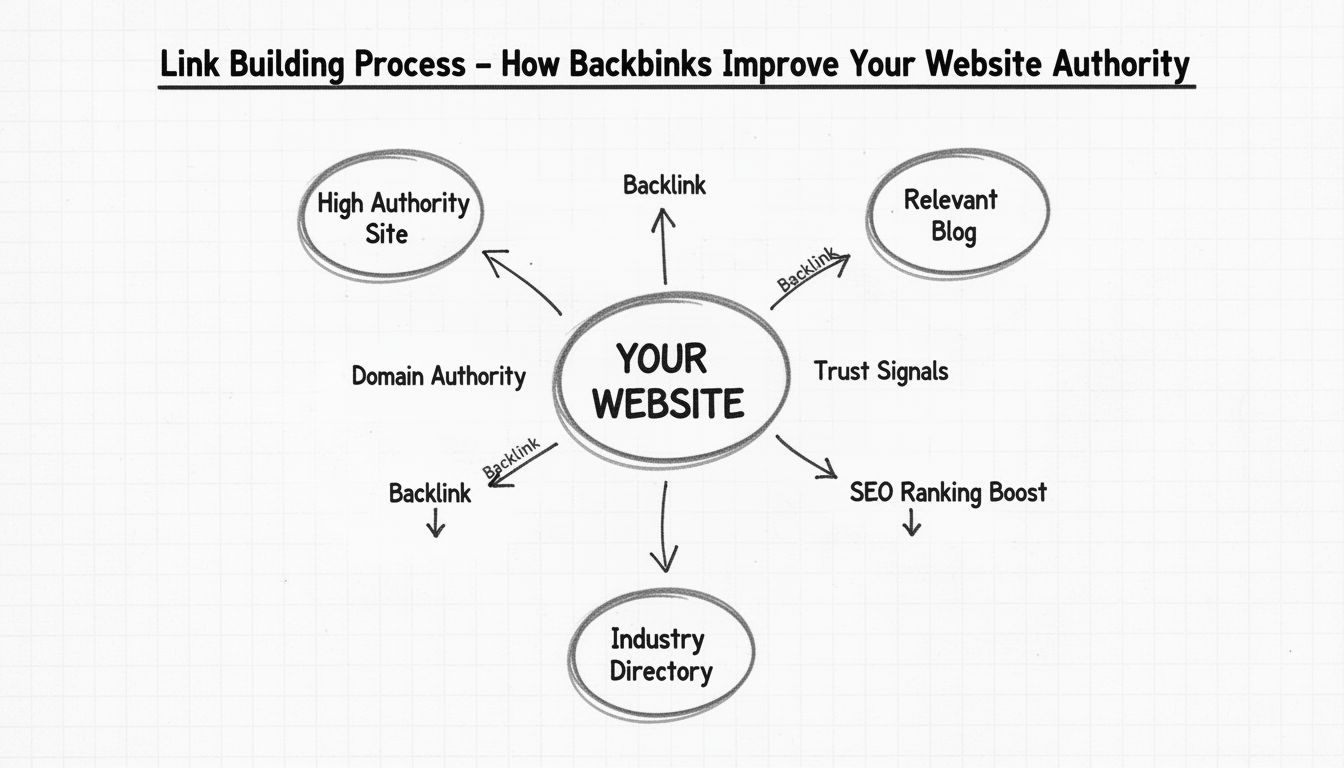
Learn what link building is and why it's crucial for SEO. Discover proven strategies to acquire high-quality backlinks and improve your website's search ranking...
Join our community of happy clients and provide excellent customer support with Post Affiliate Pro.




Cookie Consent
We use cookies to enhance your browsing experience and analyze our traffic. See our privacy policy.