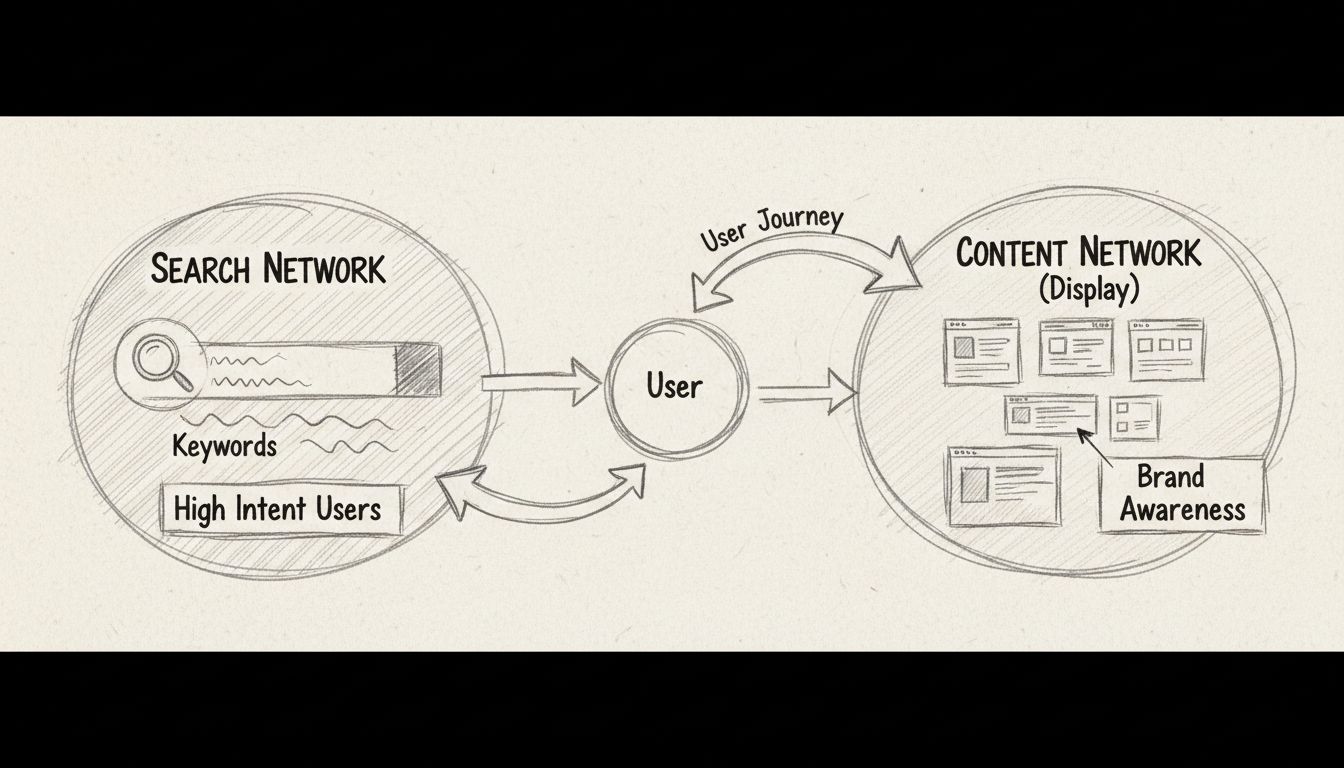
Every dollar you spend on digital advertising lands in one of two ecosystems: someone is either actively searching for an answer, or passively browsing content. Understanding which ecosystem you are buying into — a search network or a content network — determines your ad formats, your targeting options, your cost structure, and ultimately your return on investment.
A search network is a group of search-related websites and apps where text-based ads appear alongside organic search results when a user types a query. A content network (now officially called the Google Display Network, or GDN) is a collection of millions of third-party websites, apps, and video platforms where visual ads appear while users consume content — not while they search.
This glossary entry defines both networks in detail, explains how they differ, and examines them from three practical perspectives: the advertiser buying the traffic, the publisher or affiliate hosting the ads, and the affiliate program manager tracking performance across both.
What Is a Search Network?
A search network is a group of search engines and search-related properties where advertisers can place text ads that appear when someone types a keyword. The dominant example is the Google Search Network, which includes Google Search itself, Google Maps, Google Shopping, Google Images, and a set of search partner sites that license Google’s search technology.
When you advertise on a search network, your ad is triggered by a user’s query. This makes search networks the highest-intent channel in digital advertising — the user has already expressed what they want, and your ad answers that demand.
How Search Networks Work
Search networks operate on a real-time keyword auction. When a user enters a search query, Google runs an auction among all advertisers bidding on keywords that match that query. Three factors determine whether your ad appears and in what position:
- Bid amount — the maximum cost-per-click (CPC) you are willing to pay.
- Ad quality — measured by expected click-through rate, ad relevance, and landing page experience, combined into a Quality Score.
- Ad rank thresholds — minimum thresholds that vary by query and prevent low-quality ads from showing.
The advertiser does not pay their full bid. The actual CPC is typically less than the maximum bid and is calculated based on the ad rank of the competitor below you. This auction runs in milliseconds for every single search.
Where Search Ads Appear
Search ads can appear across several Google-owned properties:
- Google Search — text ads above and below organic results on google.com.
- Google Maps — ads within map results, often for local businesses.
- Google Shopping — product listing ads with images, prices, and merchant names.
- Google Images — text and shopping ads within image search results.
- Search partner sites — third-party sites that use Google’s search engine, such as Amazon, Ask.com, and YouTube’s search function. These extend your reach beyond Google’s own properties.
Types of Ads on the Search Network
| Ad Type | Description | Best Use Case |
|---|
| Text Ads | Standard headline-and-description ads appearing above or below search results. | Most common; direct response and lead generation. |
| Responsive Search Ads | Multiple headlines and descriptions submitted; Google tests combinations and serves the best performer. | Maximizing relevance across many queries. |
| Dynamic Search Ads | Auto-generated from your website content; no keyword list needed. | Large inventories or sites with frequently changing content. |
| Shopping Ads | Product images, prices, and merchant names in a carousel or grid. | E-commerce and product-based businesses. |
Launch your affiliate program today
Set up advanced tracking in minutes. No credit card required.
What Is a Content Network?
A content network is a vast collection of websites, mobile apps, and video platforms where advertisers can display visual ads to users who are browsing content rather than actively searching.
It includes Google-owned properties like YouTube and Gmail, plus millions of independent publisher sites that have opted in to show Google-served ads.
How Content Networks Work
Content networks use three primary targeting methods to decide where your ads appear:
- Contextual targeting — Google scans the content of a webpage and matches your keywords to relevant pages. If you sell running shoes, your ad might appear on a marathon training blog.
- Placement targeting — you choose specific websites, apps, or YouTube channels where you want your ads to run. This gives you direct control over where your brand appears.
- Audience targeting — you target users based on demographics, interests, browsing behavior, or whether they have previously visited your site (remarketing). This targets the person, not the page.
Unlike search networks, content networks do not rely on user queries. The ad appears because the context of the page or the profile of the user matches your targeting criteria.
Where Content Network Ads Appear
- Publisher websites — news sites, blogs, forums, and content sites that host Google AdSense units.
- Mobile apps — in-app banner, interstitial, and native ad placements.
- YouTube — video ads before, during, or alongside video content.
- Gmail — expandable ads that appear in the Promotions and Social tabs.
Types of Ads on Content Networks
| Ad Type | Description | Best Use Case |
|---|
| Banner Ads | Static or animated image ads in standard sizes (728×90, 300×250, etc.). | Brand awareness and retargeting. |
| Responsive Display Ads | Upload images, headlines, and logos; Google auto-adjusts size and format to fit available ad slots. | Scaling reach across diverse placements. |
| Video Ads | Skippable or non-skippable video creatives, primarily on YouTube. | Storytelling, product demos, brand building. |
| Rich Media Ads | Interactive ads with animation, audio, or expandable elements. | High-engagement campaigns where interaction matters. |
Search Network vs. Content Network — Key Differences
The two networks serve fundamentally different moments in a customer’s journey. Understanding these differences prevents wasted budget and misaligned expectations.
User Intent and Behavior
On the search network, the user has declared their intent. They typed “emergency plumber near me” or “best CRM for small business.” Your ad answers an existing demand. This is pull marketing — the user pulls information toward themselves.
On the content network, the user is consuming content — reading an article, watching a video, checking email. Your ad interrupts that experience to create demand or reinforce awareness. This is push marketing — you push your message to the user.
The practical consequence: search network campaigns typically convert at higher rates because the user is already in a buying mindset. Content network campaigns generate lower direct conversion rates but build the awareness and familiarity that make search conversions possible later.
Search network ads are predominantly text-based. You need compelling headlines and descriptions — no images, no video. The constraint forces clarity.
Content network ads are visual. You need images, logos, and often video assets. A poorly designed banner does not just underperform — it can harm brand perception if it appears on low-quality placements.
Targeting Methods Compared
| Dimension | Search Network | Content Network |
|---|
| Primary trigger | User search query | Page context or user profile |
| Targeting basis | Keywords, location, device, audience | Keywords, topics, placements, demographics, interests, remarketing lists |
| User state | Active, intent-driven | Passive, browsing |
| Typical ad format | Text | Image, video, rich media |
| Primary metric | Conversions, CPA | Impressions, reach, assisted conversions |
Cost Structures and Conversion Rates
Search network campaigns typically operate on a cost-per-click (CPC) model.
Content network campaigns often use cost-per-thousand-impressions (CPM) or cost-per-view (CPV) for video.
Use view-through conversion tracking and multi-touch attribution to understand how display impressions contribute to eventual search conversions and direct visits.
Join our newsletter
Be the first to know about new features and product updates.
Search Partners — What They Are and When to Use Them
Search partner sites are third-party websites and apps that have integrated Google’s search functionality and agree to show Google Ads alongside their own search results. Examples include Amazon (which uses Google search technology for parts of its site), Ask.com, and various smaller search engines and directory sites.
What Are Search Partner Sites?
When you create a Google Search campaign, the “Include search partners” option is enabled by default. This extends your text ads beyond Google’s own properties to these partner sites. The logic is appealing: more reach at no additional setup effort.
Should You Enable Search Partners?
Here is what the data shows:
Arguments for enabling search partners:
- Additional conversions at potentially lower CPCs than Google Search alone.
- Extended reach to audiences who use alternative search platforms.
- Minimal management overhead — the same campaigns and keywords apply.
Arguments against enabling search partners:
- Conversion rates on partner sites are often lower than on Google Search proper, because the user experience and search intent on partner sites differ.
- Limited transparency — you cannot see which partner sites your ads appeared on or exclude specific partners individually.
- Some partners are low-quality parked domains or junk sites that generate accidental clicks.
Current recommendation: For new campaigns, start with search partners disabled. Establish a baseline conversion rate and CPA on Google Search alone. Then enable search partners as a separate experiment. If partner traffic converts profitably, keep it. If it burns budget without converting, disable it — you can only opt out of all search partners, not individual ones.
How These Networks Fit Affiliate Marketing
Search and content networks are not just tools for direct advertisers. They are integral to the affiliate marketing ecosystem, and each stakeholder — advertiser, publisher, and program manager — interacts with them differently.
For Advertisers
Advertisers running affiliate programs use search networks to capture high-intent traffic for their own products — often bidding on branded and category keywords. Content networks serve a different purpose: building brand awareness and retargeting users who visited but did not convert.
This lets advertisers measure which network drives the most assisted conversions, not just last-click sales. A common pattern: content network ads introduce the brand, search network ads close the sale, and affiliate partners capture demand from both channels.
For Publishers and Affiliates
Affiliate publishers — bloggers, review sites, coupon sites, and content creators — monetize their traffic through a mix of display ads and affiliate links. Here, the content network is the publisher’s revenue source: they host Google AdSense or other display ad units on their pages and earn per impression or per click.
Savvy affiliates also use search networks as a traffic source. They bid on long-tail product-review keywords, send that traffic to a landing page with affiliate links, and earn commissions on resulting sales. This is a common affiliate model, but it requires careful attention to the advertiser’s terms — some affiliate programs restrict or prohibit bidding on branded keywords.
For Affiliate Program Managers
Program managers need visibility into how affiliates drive traffic — and which networks that traffic comes from. Modern affiliate software tracks the referrer, campaign ID, and conversion path for each affiliate-generated sale.
This matters because not all traffic is equal. A sale attributed to an affiliate who ran a content network banner campaign may have been assisted by a search ad the advertiser ran independently. Without cross-network tracking, the program manager risks double-counting conversions or overpaying commissions on sales that would have happened anyway.
Set commission rules that reward affiliates for incremental value rather than last-click poaching.
Practical Tips for Each Network
Raising CTR on the Search Network
Click-through rate on the search network is a function of ad relevance, visibility, and trust signals. Specific, tested tactics that improve CTR include:
- Use all available ad extensions. Sitelinks, callouts, structured snippets, and call extensions increase the physical size of your ad on the SERP, making it more prominent. Ads with extensions consistently outperform those without.
- Add negative keywords aggressively. Every click on an irrelevant query lowers your CTR and wastes budget. Review the search terms report weekly and add non-converting queries as negative keywords.
- Test ad copy continuously. Run at least two ads per ad group. Google will optimize delivery toward the higher-performing variant, but you should still manually review and refresh creatives monthly.
- Use countdown timers and price extensions for promotional campaigns. These create urgency and set clear expectations before the click.
Optimizing Content Network Campaigns
Content network campaigns require a different optimization approach — quality control matters as much as bid management.
- Exclude low-quality placements. Review the “Where ads showed” report regularly. Exclude mobile apps that generate accidental clicks, parked domains, and sites irrelevant to your audience. This is the single highest-impact optimization for display campaigns.
- Set frequency caps. Limit how many times a single user sees your ad per day. A frequency of 3–5 impressions per day is typical for awareness campaigns; higher frequencies often irritate users and waste budget.
- Rotate creatives. Banner fatigue is real. Refresh your image assets every 4–6 weeks. Responsive display ads help by auto-generating variations, but you should still upload fresh source images periodically.
- Layer targeting methods. Combine contextual keywords with audience targeting for precision. For example, target users in your remarketing list who are also browsing pages about a specific topic — this reaches warm audiences in relevant contexts.
- Use view-through conversion windows wisely. A 30-day view-through conversion window can inflate perceived performance. For most campaigns, a 7-day window provides a more realistic picture of display’s contribution.
Obsolete Terms and Modern Equivalents
References to “AdWords” in older articles are not wrong about the mechanics, but the platform name has changed.
- “Content targeting” is not the same as “contextual targeting.” Content targeting broadly refers to any ad placement on content sites. Contextual targeting specifically means matching ads to page content using keyword analysis — a subset of content network targeting.
Using current terminology matters in client-facing documents, job interviews, and professional writing. It signals that your knowledge is up to date.