


What Does Indexing Mean in SEO?
Learn what SEO indexing means, how it works, and why it's critical for your website's search visibility. Discover best practices to ensure your pages get indexe...
11 min read
Search engine optimization (SEO) is the practice of improving a website and its content so that search engines such as Google, Bing, and Yahoo can better understand it, rank it for relevant queries, and show it to the right people in organic — unpaid — search results.
Search engine optimization (SEO) is the practice of improving a website and its content so that search engines such as Google, Bing, and Yahoo can better understand it, rank it for relevant queries, and show it to the right people in organic — unpaid — search results. It is not a one-time fix or a trick for manipulating rankings. Done well, SEO makes a site more useful for visitors and more legible to the automated crawlers that build search indexes.
Every second, thousands of people type questions, product names, and research topics into search engines. SEO determines whether your pages appear among the top results for those queries or sit unseen on page five. For businesses, publishers, and affiliate program managers who depend on web traffic to generate leads, sales, or commissions, SEO is the difference between being discovered and being invisible.
On this page
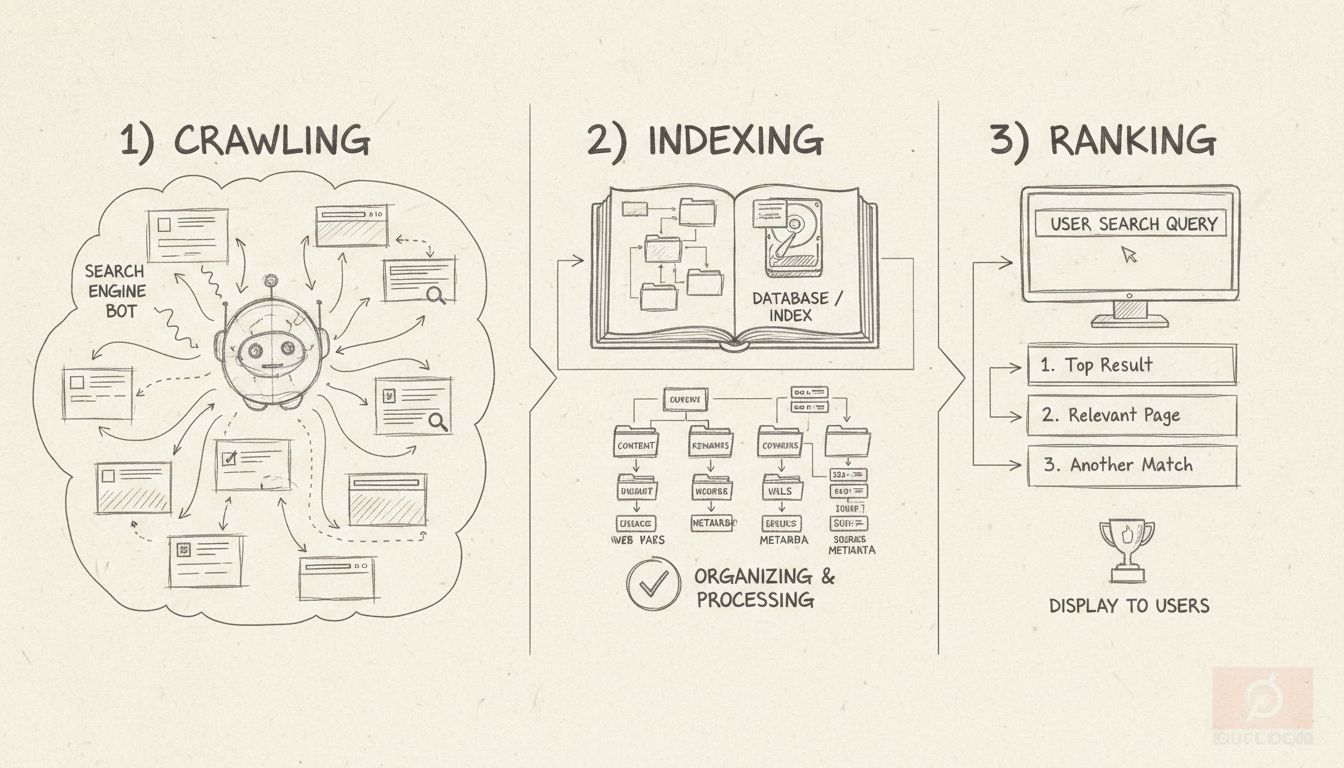
To understand what SEO does, it helps to know what happens between typing a query and seeing a results page. Google and other search engines run a three-stage process:
SEO influences all three stages. Technical improvements help crawlers find and read pages. Content choices determine what a page gets indexed for. And the signals a page sends — through links, structure, freshness, and user behavior — shape where it ranks.

Set up advanced tracking in minutes. No credit card required.
Most SEO work falls into three categories that reinforce one another: on-page SEO, off-page SEO, and technical SEO.
On-page SEO covers everything visible on a page and the HTML that describes it. Key elements include:
Off-page SEO is about signals that originate outside your own website, primarily links from other sites. A link from a reputable, topically relevant website acts as a vote of confidence. Search engines interpret the quantity, quality, and relevance of these incoming links — often called backlinks — as evidence of authority.
Other off-page factors include brand mentions across the web, social media signals, and citations in directories or industry publications. The common thread is that off-page SEO builds trust signals that a site cannot simply declare for itself.
Technical SEO ensures that a site meets the infrastructure requirements search engines need to crawl, index, and render pages correctly. Core areas include:
Optimization is not about gaming an algorithm. It means aligning a page with what search engines look for and what users need. Those two goals increasingly overlap.
A page optimized for “what is search engine optimization” should define the term clearly, explain how it works, distinguish it from paid search, and answer follow-up questions a reader is likely to have — all in language that matches how people actually search. Optimization also means structuring that information so crawlers can parse it: descriptive URLs, proper heading hierarchy, and semantic HTML elements such as <main>, <nav>, and <article>.
| Practice | Status in 2026 | Why |
|---|---|---|
| Keyword stuffing | Obsolete | Triggers spam penalties; degrades readability |
| Writing for users first | Current best practice | Google’s helpful content system rewards people-first content |
| Buying backlinks | Obsolete and risky | Violates Google’s spam policies; can result in manual actions |
| Earning editorial backlinks | Current best practice | Genuine endorsements from reputable sites build sustainable authority |
| Cloaking (showing different content to crawlers vs. users) | Obsolete and prohibited | Direct violation of webmaster guidelines |
| Using structured data | Current best practice | Enables rich results and helps crawlers understand content meaning |
| Exact-match keyword domains | Largely irrelevant | Google downranked low-quality exact-match domains years ago |
| Creating comprehensive, well-structured content | Current best practice | Satisfies search intent and earns links naturally |
Be the first to know about new features and product updates.
These three acronyms are often confused. Here is how they relate:
In practice, many marketers use “SEM” to mean paid search specifically. The distinction that matters: SEO builds long-term, compounding visibility that continues without a per-click cost. PPC delivers immediate exposure that stops the moment the budget runs out. The two channels complement each other; most mature digital marketing strategies use both.
Early tactics — stuffing keywords into meta tags, building link farms, spinning low-quality articles — worked briefly and then stopped working as search engines grew more sophisticated.
Key shifts over the past two decades:
The trajectory is clear: search engines get better every year at identifying content that genuinely serves users. SEO that tries to outsmart algorithms instead of serving readers is a losing long-term strategy.
SEO is not instant. After publishing or updating a page, some changes may be reflected in search results within hours; others can take several months. Google itself advises waiting at least a few weeks before assessing whether changes had an effect, and notes that not every change produces a noticeable impact.
Typical timelines:
| Action | Approximate Time to See Movement |
|---|---|
| Fixing a critical technical error (e.g., unblocking a robots.txt restriction) | Days to weeks |
| Publishing new content on an established, authoritative site | Weeks to a few months |
| Building a new site from scratch | 6–12 months for competitive terms |
| Earning and accumulating quality backlinks | 3–12 months, cumulative |
| Recovering from a manual penalty | Weeks to months after the fix is accepted |
Patience and consistency matter more than any single tactic. SEO compounds: work done in month one continues to pay off in month twelve, and gains build on each other.
SEO and affiliate marketing intersect in specific, practical ways.
An advertiser — the merchant or brand that offers an affiliate program — benefits from SEO in two directions. First, the brand’s own site needs to rank for product and category terms to capture direct sales. Second, the affiliate program landing page must be findable so potential publishers can discover it when searching for programs to join.
A well-optimized affiliate signup page includes:
Publishers — the bloggers, review sites, and content creators who promote affiliate products — depend on SEO for nearly all their traffic. A product comparison or review that ranks well can generate commissions for years without ongoing ad spend.
Practical steps for affiliate publishers:
Program managers sit between advertisers and publishers. SEO knowledge helps them:
SEO is powerful but not unlimited. For affiliate stakeholders, key limitations include:
SEO without measurement is guesswork. Key metrics and tools include:
Regular reporting cadences — monthly for most sites, weekly for large or fast-moving ones — help separate signal from noise and catch problems before they compound.
Yes. For a small to medium-sized site, the fundamentals are learnable and doable without hiring an agency. The starting points:
When a site grows large, operates in a highly competitive niche, or faces technical challenges like internationalization or complex site architecture, a professional SEO consultant or agency becomes more valuable.
SEO is a skill that rewards consistent learning because search engines evolve.
Is SEO difficult to learn? The core concepts are straightforward. The challenge is that SEO sits at the intersection of writing, technology, and analytics. Mastering all three takes time, but functional competence — enough to improve a site’s visibility meaningfully — is achievable within months of consistent effort.
Leverage effective SEO strategies to increase your website’s visibility, drive organic traffic, and maximize affiliate marketing success with Post Affiliate Pro.
Learn what SEO indexing means, how it works, and why it's critical for your website's search visibility. Discover best practices to ensure your pages get indexe...
A search engine is software created to make searching on the internet easier for users. It searches millions of pages and provides the most relevant results.
On-page SEO optimizes webpage content and HTML to rank higher in search engines and attract relevant organic traffic.
Join our community of happy clients and provide excellent customer support with Post Affiliate Pro.




Cookie Consent
We use cookies to enhance your browsing experience and analyze our traffic. See our privacy policy.