Strength of Competition (SOC) is a metric that estimates how difficult it is for a webpage to rank in search engine results for a specific keyword, based on the number and authority of competing pages already targeting that term. Unlike simple volume-based metrics, SOC evaluates the competitive pressure surrounding a keyword — how entrenched existing pages are, how strong their backlink profiles look, and how thoroughly they satisfy search intent. In affiliate marketing and SEO, SOC helps practitioners decide whether a keyword is worth pursuing or whether the fight will consume more resources than the potential return justifies.
What Is the Definition of Competition in SEO?
Before understanding SOC, it helps to define what “competition” means in a search context. Competition refers to the set of rival pages and domains that are also trying to rank for the same keyword or topic. These competitors invest in content, backlinks, technical optimization, and user experience to capture organic clicks. The more capable and numerous those rivals are, the higher the competitive intensity — and the harder it is for a new or weaker page to break into the top results.
In SEO, competition is not a binary state. It exists on a spectrum. A keyword with three moderately optimized pages from low-authority sites represents a different competitive situation than one where the top 10 results are controlled by brands with millions of referring domains. SOC attempts to quantify that spectrum into a usable score.
Launch your affiliate program today
Set up advanced tracking in minutes. No credit card required.
What SOC Actually Measures
SOC is a composite metric. It does not rely on a single signal. The most common inputs include:
- Number of competing pages: How many URLs actively target the same keyword in their title tags, headings, and body content.
- Domain and page authority: The relative strength of the domains ranking in the top positions, measured through backlink profiles, referring domains, and trust signals.
- On-page optimization: How well competing pages align with the keyword — title structure, semantic coverage, internal linking, and content depth.
- Backlink concentration: The volume and quality of links pointing to the top-ranking pages. A keyword where the top three results each have hundreds of referring domains will carry a higher SOC.
- Content quality signals: Comprehensiveness, freshness, and how well the content satisfies the searcher’s intent.
Different tools weight these factors differently. Micro Niche Finder, one of the earliest tools to popularize the term SOC, calculated it by combining inurl:, intitle:, and inanchor: search operator counts — essentially measuring how widely the keyword phrase appeared in URLs, title tags, and anchor text across the web. That approach gave a relative sense of saturation but did not measure the actual strength of individual competing pages.
Modern tools have evolved beyond this. Ahrefs, Semrush, and Moz each calculate their own competition scores using proprietary blends of backlink data, domain authority, and content analysis.
SOC vs. Keyword Difficulty: What Are the Three Areas of Competition?
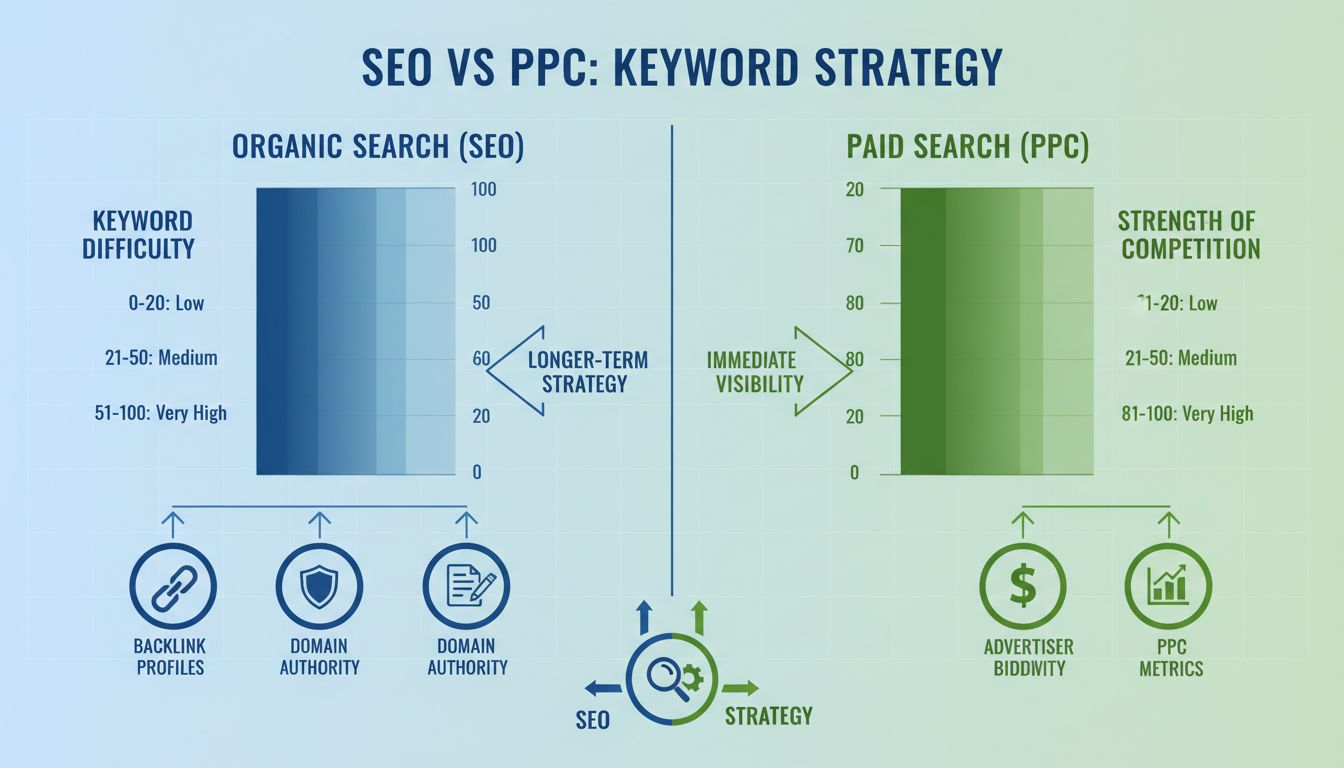
1. Organic Search Competition (KD)
Keyword Difficulty measures how hard it is to rank in organic search results. It focuses on the backlink profiles, domain authority, and content quality of the pages already ranking. This is the domain of SEO practitioners and content marketers.
2. Paid Search Competition (Competitive Density)
In Google Ads, competition refers to the number of advertisers bidding on a keyword. Google’s Competitive Density metric runs from 0 to 1, where values near 1 indicate heavy advertiser activity. This drives up cost-per-click (CPC) and determines whether a keyword is affordable for a given budget. SOC in its original paid-search sense is closer to this metric.
3. SERP Feature Competition
A third, often overlooked area is competition from SERP features — featured snippets, AI Overviews, knowledge panels, video carousels, and “People Also Ask” boxes. These elements can push organic listings down the page, reducing click-through rates even when you rank in position one. A keyword with heavy SERP-feature presence raises the effective competition level beyond what traditional SOC or KD scores capture.
Understanding which area of competition matters for your strategy prevents misallocated effort. An affiliate marketer focused on organic traffic should prioritize KD over Competitive Density. A media buyer running paid campaigns should do the opposite.
Join our newsletter
Be the first to know about new features and product updates.
| Tool | Metric Name | Scale | Primary Inputs | Best For |
|---|
| Micro Niche Finder (legacy) | SOC | Numeric score | inurl:, intitle:, inanchor: counts | Early-stage keyword filtering (obsolete as a standalone) |
| Ahrefs | Keyword Difficulty | 0–100 | Referring domains to top 10 pages | Organic SEO planning |
| Semrush | Keyword Difficulty % | — | Median referring domains, authority scores, SERP features, search volume | Organic and paid strategy |
| Semrush | Competitive Density | 0.00–1.00 | Number of advertisers bidding | Google Ads budgeting |
| Moz | Keyword Difficulty | 0–100 | Page Authority, Domain Authority (40+ factors) | Organic ranking potential |
| Google Keyword Planner | Competition | Low / Medium / High | Advertiser bidding activity | PPC campaign planning |
Each tool defines the competitive playing field differently. The practical takeaway: pick one tool as your primary source of truth and use it consistently. Comparing SOC scores across platforms produces unreliable conclusions.
Why SOC Matters in Affiliate Marketing
Affiliate marketing operates on thin margins and long feedback loops. A publisher might spend weeks creating content, building links, and waiting for rankings — only to discover the keyword was too competitive to crack. SOC exists to prevent that scenario.
For Publishers and Content Creators
Publishers use SOC during keyword research to filter out terms where the competitive environment is hostile to newer or lower-authority sites. A keyword with high search volume and strong buyer intent looks attractive on the surface. But if the SOC score is high and the top 10 results are dominated by established media brands, the realistic path to page one may be years long.
A practical workflow for publishers:
- Generate a keyword list using a seed term relevant to your niche.
- Filter by SOC or KD score, keeping only keywords below a threshold appropriate for your site’s current authority (e.g., KD under 30 for a site with Domain Rating below 40).
- Manually inspect the top 5 results for each remaining keyword. Look at domain authority, content depth, and whether any weaker sites have managed to rank — a sign that the SERP is not locked down.
- Prioritize keywords where you can differentiate — either through better content, a unique angle, or stronger supporting assets.
For Affiliate Program Managers
Program managers evaluating potential publishing partners can use SOC to understand the competitive landscape their affiliates face. If an affiliate is targeting high-SOC keywords, they may need additional support — content resources, exclusive offers, or higher commission rates — to compete effectively. Conversely, affiliates targeting low-SOC keywords may deliver faster results with less investment.
For Advertisers Running Paid Campaigns
In paid search, SOC (as Competitive Density) directly affects cost. High-density keywords drive up CPCs and may require larger budgets to maintain impression share. Advertisers should cross-reference Competitive Density with conversion data to identify keywords where the cost of competition is justified by the return.
What Are Some Common Weaknesses of Business Competitors?
When assessing SOC manually — as every practitioner should — you are not just measuring strength; you are looking for weaknesses in the competitive field. Common weaknesses that create opportunities even in high-SOC environments include:
- Thin or outdated content: Pages that rank despite being short, superficial, or years out of date. A comprehensive, current alternative can displace them.
- Poor on-page optimization: Missing or weak title tags, lack of structured headings, slow page speed, and poor mobile experience.
- Low topical authority: Sites that rank for a keyword incidentally, without broader coverage of the topic area. A site with deep topical authority can often outrank a stronger domain that only touches the subject once.
- Weak internal linking: Pages that rank despite being orphaned or poorly connected within their own site architecture.
- No supporting media: Competitors relying solely on text, leaving an opening for pages with custom images, video, data visualizations, or interactive elements.
- Slow load times: Core Web Vitals matter. A fast, clean page can outrank a slower competitor with more backlinks.
Identifying these weaknesses turns SOC from a gatekeeper metric into a strategic targeting tool. A keyword with a high SOC score may still be winnable if the top-ranking pages share a common vulnerability.
How to Analyze Competitor Social Media and Content Strategy
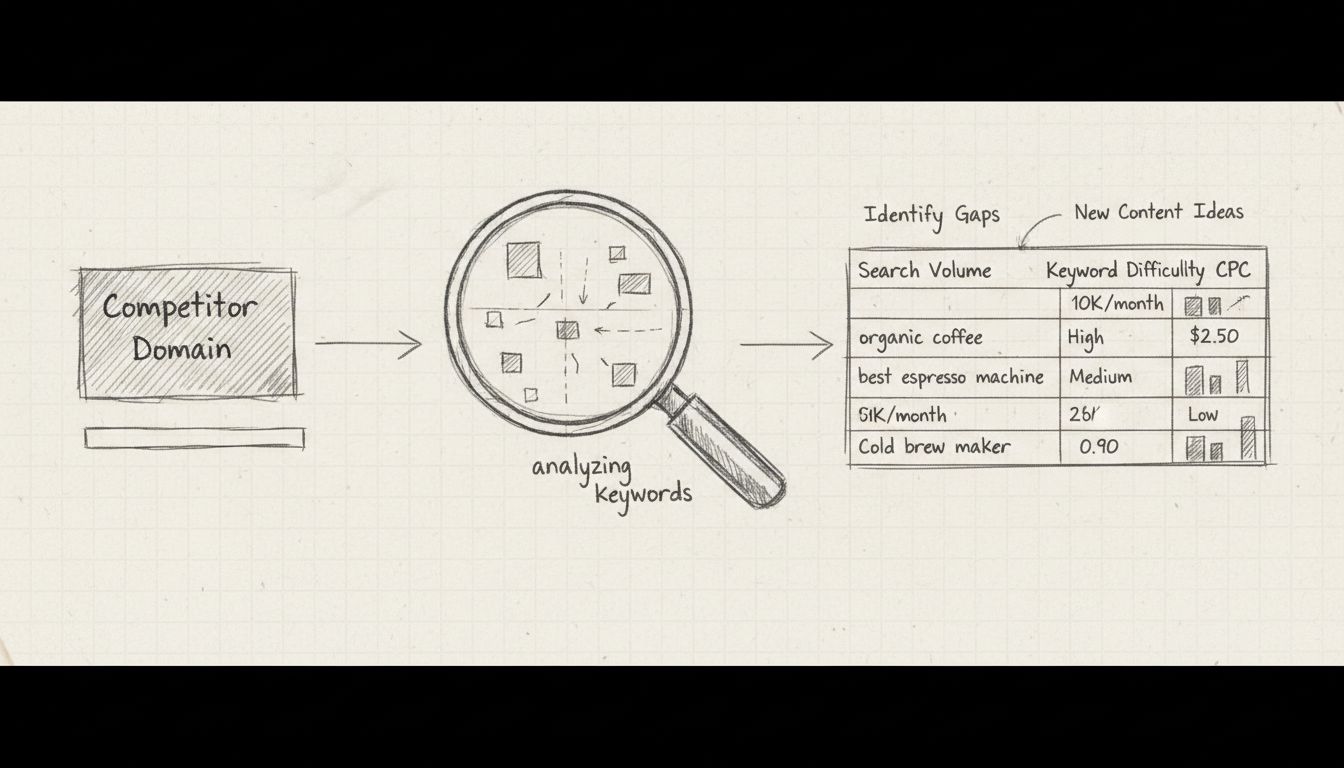
SOC analysis should extend beyond search metrics. Competitor content and social media strategy reveal how rivals attract and engage audiences — and where gaps exist.
Content Strategy Analysis
- Map competitor content by topic cluster. Identify which subjects they cover in depth and which they ignore.
- Evaluate content formats. Are competitors using long-form guides, listicles, video, podcasts, or interactive tools? Format gaps are content opportunities.
- Check publishing frequency. Sites publishing consistently signal commitment and topical authority. Inconsistent publishers leave openings.
- Review content freshness. Outdated articles with stale statistics or obsolete advice are vulnerable to replacement.
- Assess engagement signals. Comments, social shares, and backlinks indicate whether content resonates with its audience.
- Identify active platforms. Which social channels drive traffic and engagement for competitors?
- Evaluate content mix. Promotional vs. educational vs. community-building content.
- Measure audience size and engagement rate. Raw follower counts matter less than engagement-per-follower ratios.
- Track brand sentiment. Are competitors’ audiences satisfied, frustrated, or indifferent?
- Note partnership and influencer activity. Affiliate relationships, sponsored content, and co-marketing efforts reveal distribution strategies.
What to Do With Your Competitive Analysis Results
Gathering SOC data and competitor intelligence is only useful if it leads to action. A structured approach to applying competitive analysis:
- Segment keywords by SOC tier. Group keywords into low-SOC (immediate targets), medium-SOC (near-term goals requiring additional investment), and high-SOC (long-term plays or not worth pursuing).
- Build content briefs targeting competitor weaknesses. For each target keyword, document what the top-ranking pages do well and where they fall short. Write briefs that explicitly address those gaps.
- Allocate resources proportionally. Low-SOC keywords may need only solid on-page optimization. Medium-SOC keywords may require link building and content upgrades. High-SOC keywords demand significant investment — proceed only when the expected return justifies the cost.
- Set realistic timelines. A low-SOC keyword might rank within weeks. A medium-SOC keyword may take months. A high-SOC keyword can take a year or more. Align stakeholder expectations accordingly.
- Monitor and iterate. Competitive landscapes shift. A keyword that is low-SOC today can become high-SOC if a major publisher enters the space. Reassess quarterly.
Limitations of SOC
SOC is a useful directional metric, but it has important limitations that practitioners should understand.
No Universal Calculation Standard
As noted above, every tool calculates SOC differently. There is no industry-wide standard. This means SOC scores are not portable across tools and should not be treated as objective truth. They are estimates, and their value depends on the quality of the underlying data and methodology.
SOC Does Not Measure Individual Page Strength
The original SOC formula used by tools like Micro Niche Finder measured keyword saturation — how many pages used the keyword in URLs, titles, and anchor text. It did not evaluate the actual authority or content quality of those pages. A keyword could have a high SOC score because thousands of weak pages use the phrase, while the top 10 results remain beatable. Modern tools have improved on this, but the limitation persists in principle: aggregate metrics can mask individual opportunity.
SOC Is a Snapshot, Not a Forecast
SOC reflects the competitive environment at a specific moment. It does not predict how competition will change. A keyword with low SOC today may attract aggressive competitors tomorrow, especially if it converts well or gains visibility.
SOC Ignores Searcher Intent Nuance
SOC treats all competing pages as equal rivals. In practice, two pages ranking for the same keyword may serve different intents. A keyword like “best running shoes” might attract listicles, single-product reviews, comparison guides, and video content — all competing for the same SERP but appealing to different user needs. SOC does not distinguish among these formats.
SOC Can Create False Confidence
A low SOC score can mislead practitioners into thinking a keyword is easy, when in fact the SERP is occupied by pages that are structurally strong but lightly optimized for the exact keyword phrase. Conversely, a high SOC score can discourage investment in a keyword where the top results are vulnerable due to outdated content or poor user experience.
Obsolete Practices vs. Current Advice
Obsolete: Relying on SOC Alone
In the early days of SEO, tools like Micro Niche Finder popularized SOC as a quick filter for keyword viability. Practitioners would set a maximum SOC threshold and discard everything above it without further analysis. This approach is obsolete. SOC should be one datapoint among several, always supplemented by manual SERP review.
Obsolete: Treating SOC as a Fixed Number
Older tools presented SOC as a static score. Modern practice recognizes that competition is dynamic. A keyword’s competitive intensity changes as new pages publish, old pages decay, and search algorithms evolve. SOC should be reassessed periodically, not treated as a one-time checkpoint.
Current: Layered Competitive Analysis
The recommended approach today layers SOC with:
- Manual review of the top 5–10 ranking pages
- Backlink profile analysis of competing domains
- Content quality and freshness assessment
- SERP feature analysis (featured snippets, AI Overviews, video results)
- Evaluation of your own site’s authority relative to the competitive field
Rather than comparing SOC scores across tools, choose one primary SEO platform and use its competition metric consistently.