


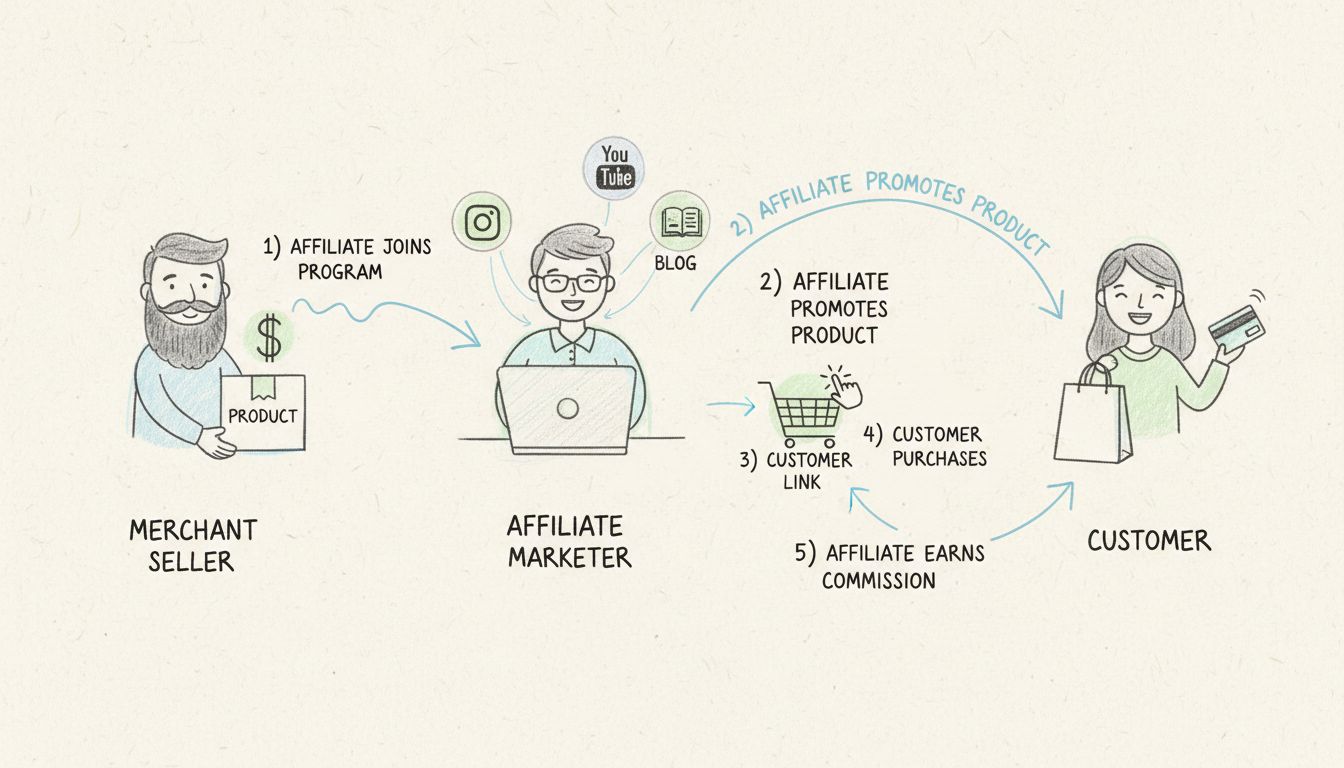
How Does Unattached Affiliate Marketing Work?
Learn how unattached affiliate marketing works with PPC campaigns, tracking links, and commission structures. Discover strategies, advantages, and best practice...
12 min read
An unattached affiliate is an affiliate marketer who promotes a product or service through paid advertising channels without any personal connection to that product, without authority in its niche, and without an established audience that trusts their recommendations.
On this page
An unattached affiliate is an affiliate marketer who promotes a product or service through paid advertising channels without any personal connection to that product, without authority in its niche, and without an established audience that trusts their recommendations. They do not use the product, they do not create content about it, and they do not build relationships with the people who might buy it. Their role is purely transactional: buy traffic, send it to an affiliate offer, and earn a commission when a sale happens.
This is the most arms-length form of affiliate marketing. It sits at the opposite end of the spectrum from the involved affiliate who tests a product, films a review, and tells their audience exactly why they recommend it. The unattached affiliate skips all of that. They go straight to the ad platform.
That framework categorizes affiliates by their relationship to the product they promote, and unattached is the category where that relationship is zero.

Set up advanced tracking in minutes. No credit card required.
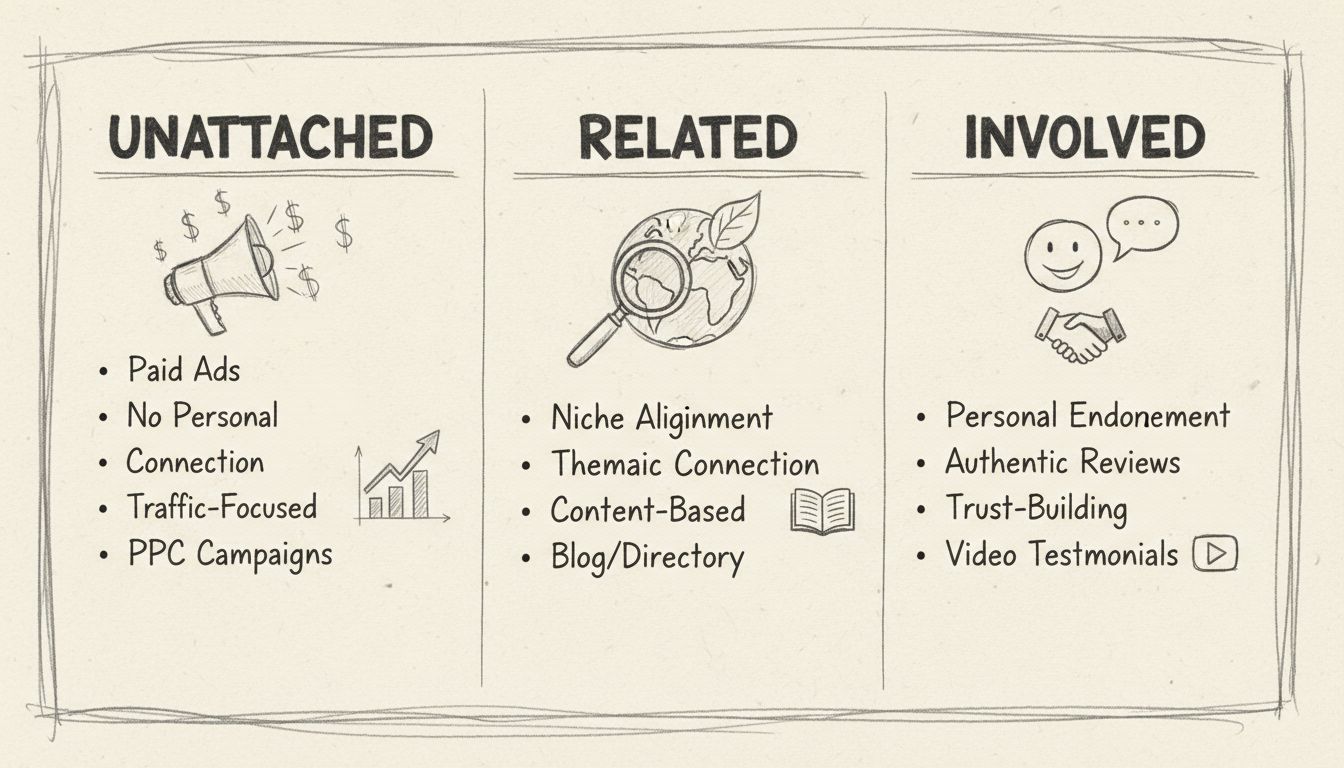
Affiliate marketers fall into three broad categories based on how closely they are connected to the products they promote. Understanding these types helps advertisers decide which affiliates to recruit and helps publishers choose a model that fits their resources.
| Type | Connection to product | Primary method | Trust level | Typical conversion rate |
|---|---|---|---|---|
| Unattached | None — never used it, no niche presence | Paid ads (PPC, display, social) | Minimal | — |
| Related | Operates in the same niche, may have used similar products | Blog posts, videos, social media content | Moderate | — |
| Involved | Personally uses and endorses the product | Reviews, tutorials, personal testimonials | High | — |
Unattached affiliates buy traffic and send it to merchant pages. They are advertisers, not creators.
Related affiliates have a niche audience — a fitness blogger promoting protein powder they have researched but not necessarily used, for example. Their audience trusts them on the topic even if they have not tried every specific product.
Involved affiliates go further: they use the product, document their experience, and recommend it from first-hand knowledge. This generates the highest conversion rates because the endorsement carries genuine weight.
The workflow is simpler than content-based affiliate marketing, but it demands a different skill set: paid media buying.
They receive a unique affiliate link that tracks every click and sale attributed to them.
Most unattached affiliates run campaigns on:
The affiliate creates ads that link either directly to the merchant’s sales page (direct linking) or to a pre-lander — a simple page that warms up the visitor before passing them to the offer. Direct linking is faster to launch but typically converts worse because the visitor arrives cold.
The affiliate monitors cost per click (CPC), click-through rate (CTR), conversion rate, and return on ad spend (ROAS). Campaigns that generate a positive ROAS get scaled; campaigns that lose money get paused or reworked. This is a numbers game: test ads, kill losers, feed winners.
Suppose an unattached affiliate joins a meal-kit delivery company’s program paying $25 per sale. They create Google Ads targeting keywords like “best meal delivery service” and “healthy meal kits delivered.” Their average CPC is $1.20, and their landing page converts at 2%. That means they need 50 clicks per sale, costing $60 in ad spend to earn $25 — a loss. To make this work, they must either find cheaper clicks, improve conversion rates, or switch to a higher-paying offer. The math drives every decision.
Be the first to know about new features and product updates.
Unattached affiliates use social media differently than influencers do. They do not build followings or post organic content. Instead, they buy ads in the feed — Facebook and Instagram sponsored posts, TikTok Spark Ads, YouTube pre-roll. The social platform is a traffic source, not a community. This is distinct from related or involved affiliates who publish blog posts, videos, and stories to nurture an audience over time.
Some unattached affiliates operate at scale through programmatic ad exchanges, placing banner and native ads across thousands of publisher sites. This approach requires sophisticated tracking and a large budget but can reach enormous audiences quickly. Affiliate networks like CJ and Rakuten Advertising support this model with APIs that feed conversion data back into the ad-buying algorithms.
Video ads on YouTube and TikTok are increasingly common for unattached campaigns. A 15-second product demo with a strong call to action and an affiliate link in the description can drive significant volume — provided the ad creative is good enough to hold attention past the “skip” button.
No personal brand required. You do not need a blog, a YouTube channel, a social media following, or any content creation skills. If you can run ads profitably, you can earn commissions.
Fast to launch. Setting up a Google Ads campaign takes hours, not months. There is no audience to build and no content calendar to fill.
Scalable with budget. When a campaign works, you can increase ad spend and grow revenue almost linearly — until the audience or keyword pool saturates.
Works across niches. Because the affiliate has no personal connection to any product, they can promote pet supplies one month and software subscriptions the next. There is no brand-consistency risk.
Measurable and data-driven. Every dollar in and out is trackable. This appeals to analytically minded marketers who prefer spreadsheets to storytelling.
High financial exposure. You pay for clicks whether or not they convert. This is the single biggest risk of the unattached model.
Low conversion rates. Without trust signals — a familiar face, a credible review, social proof — cold traffic converts at a fraction of the rate that warm audience traffic does.
No brand loyalty or repeat customers. The affiliate owns no relationship with the buyer. Every sale is a one-off transaction. There is no email list, no returning audience, and no compounding value over time.
Platform dependency. Your entire business lives on Google Ads or Meta Ads. A policy change, account suspension, or algorithm update can end your revenue overnight.
Competition and bid inflation. The low barrier to entry means many affiliates compete for the same keywords, driving up CPCs. In competitive verticals like finance or health, ad costs can exceed commission payouts.
Compliance risk. Unattached affiliates who run ads without proper disclosure — or who make claims the merchant did not approve — risk having their affiliate accounts terminated and commissions reversed.
Unattached affiliates serve a specific role in an affiliate program’s mix: they drive volume. They reach audiences that content-based affiliates cannot — people searching for “buy protein powder” who have never read a fitness blog. For merchants, unattached affiliates are a paid acquisition channel managed through the affiliate software rather than through the internal marketing team.
Because unattached affiliates send traffic from multiple ad platforms, your affiliate software needs to handle:
Unattached affiliates often prefer CPA (cost per action) or revshare models. Revenue share works too if the merchant’s average order value and lifetime value are high enough to justify the affiliate’s ad spend. Pay-per-click arrangements are rare in unattached deals because the merchant takes on all the conversion risk.
| Dimension | Unattached | Related | Involved |
|---|---|---|---|
| Personal use of product | Never | Sometimes | Always |
| Niche authority | None | Yes | Yes, deep |
| Content creation | None | Blog posts, videos, social | Reviews, tutorials, case studies |
| Traffic source | Paid ads | Organic + social + email | Organic + social + email |
| Audience relationship | None | Growing | Established, loyal |
| Startup cost | High (ad spend) | Low (time investment) | Low (time investment) |
| Time to first sale | Hours to days | Weeks to months | Weeks to months |
| Scalability ceiling | Budget-limited | Audience-limited | Trust-limited |
| Long-term asset built | None | Content library + audience | Personal brand + audience |
| — | Yes — in ad copy or landing page | Yes — in content near link | Yes — in content near link |
Blind direct linking to low-quality offers. In the mid-2010s, unattached affiliates could profit by sending cheap display traffic straight to ClickBank offers with no pre-sell page. Ad platforms have since tightened quality standards, and consumers have grown more skeptical. Sending cold traffic directly to a sales page without any context now produces dismal conversion rates.
Spammy ad copy with exaggerated claims. “Lose 20 pounds in 3 days” style ads get flagged by automated review systems and damage the merchant’s brand. Ad platforms ban repeat offenders.
Cookie-only tracking reliance. With Safari and Firefox blocking third-party cookies by default and Chrome phasing them out, unattached affiliates who depend solely on browser cookies for attribution lose a significant portion of their tracked conversions. Server-side tracking and first-party cookie solutions are now essential.
Pre-landers with genuine value. A short page that explains the product, addresses objections, and includes a clear affiliate disclosure converts far better than a raw link. Even a 300-word page with three bullet points and a testimonial snippet can double conversion rates.
Ad creative that looks native. Ads that match the look and feel of the platform they appear on — TikTok-style vertical video, search ads with tightly relevant ad extensions — outperform generic banner ads.
First-party data and server-side tracking. Affiliates who use tracking software that logs clicks server-side and sets first-party cookies preserve attribution accuracy regardless of browser restrictions.
AI-assisted campaign optimization. Tools like Google’s Performance Max campaigns use machine learning to distribute ad spend across channels automatically. Affiliates who feed accurate conversion data back into these systems get better results than those managing bids manually. AI also helps generate and test ad variations at scale — something manual split-testing could never match.
Browse offers by category and commission rate.
Choose one traffic source. Do not spread across five platforms at once. Pick Google Ads (highest intent) or Meta Ads (best targeting) and learn it thoroughly before expanding.
Track every dollar against conversions.
Build a simple pre-lander. Use a tool like Carrd or a basic WordPress page. Include the product name, three key benefits, one objection handled, and a clear call to action with your affiliate link.
Launch, measure, iterate. Run ads for at least 3–5 days before judging performance. Kill ads with a ROAS below 1.0, scale ads above 2.0. Repeat.
Yes — and unattached affiliate marketing is the primary way to do it. You do not need a social media following, an email list, or a YouTube channel. You need ad budget, a working knowledge of one ad platform, and the discipline to track return on spend.
The barrier to entry is low in terms of audience-building but moderate in terms of paid-media competence.
Yes — but the distribution is uneven. Among unattached affiliates specifically, profitability depends entirely on ad-buying skill. Some earn six figures annually running campaigns at scale; many more lose their test budget and quit.
A realistic expectation for a new unattached affiliate: expect to break even after 3–6 months of testing if you treat it as a serious business.
Yes — affiliate marketing is legal in the United States and most countries. However, it is regulated.
This means the affiliate must tell consumers that they earn a commission on purchases made through their links. The disclosure must appear near the affiliate link or ad — not buried in a footer or a separate page.
For unattached affiliates running ads, disclosure options include:
The key principle: the disclosure must be impossible to miss. A consumer should understand the commercial relationship before they click.
Artificial intelligence has changed how unattached affiliates operate in several practical ways:
These tools do not replace the need for strategy, but they make the unattached affiliate’s core job — buying traffic profitably — faster and more precise than it was five years ago.
Master the essentials of affiliate marketing and discover which model fits your business goals best.
Learn how unattached affiliate marketing works with PPC campaigns, tracking links, and commission structures. Discover strategies, advantages, and best practice...
Discover the differences between unattached, related, and involved affiliate marketing. Learn which strategy works best for your business and how PostAffiliateP...

Discover the key advantages of unattached affiliate marketing including quick setup, scalability, and minimal expertise requirements. Learn how to maximize earn...
Join our community of happy clients and provide excellent customer support with Post Affiliate Pro.



Cookie Consent
We use cookies to enhance your browsing experience and analyze our traffic. See our privacy policy.