Why 2025 Strategies Are Now Liabilities
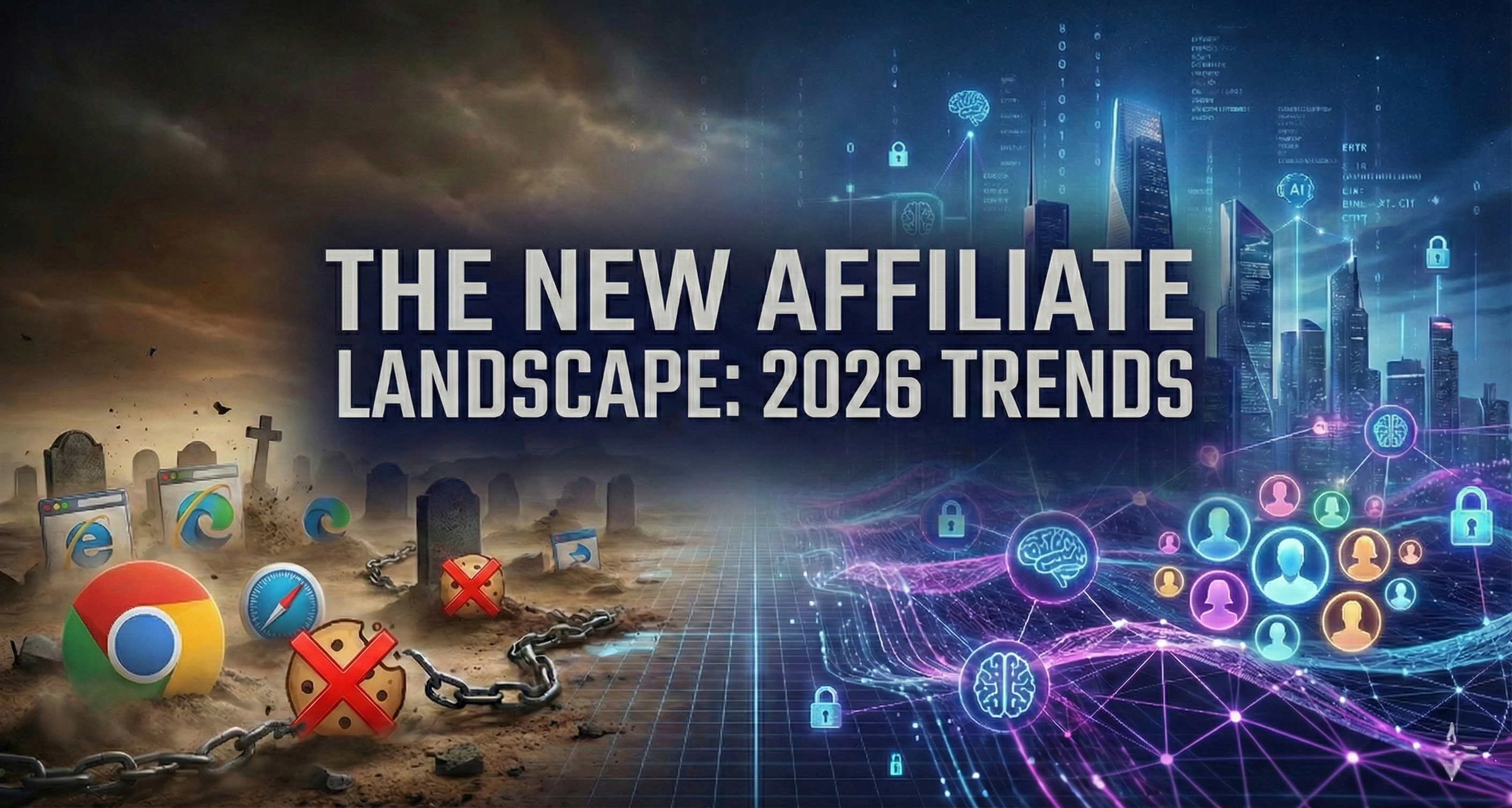
The affiliate marketing playbook that worked in 2025 is actively working against you in 2026. The industry is no longer rewarding scale and shortcuts — it’s rewarding authenticity, precision, and data-driven decision-making.
Three shifts are forcing the change. Third-party cookies have become unreliable, with consent opt-out rates between 30% and 50% in strict-privacy regions. Around 37% of desktop users now run ad blockers, creating a roughly 30% blind spot in revenue reporting. And 62% of affiliate-driven traffic now originates from mobile devices, where in-app checkout and short-form video dominate discovery.
The programs and creators winning in this environment combine AI efficiency with human authenticity, and they are shifting from last-click tracking toward multi-touch attribution built on first-party data. Here are the 10 trends defining that shift, and the concrete steps to act on each one.
Trend 1: AI-Driven Automation (But Authenticity Still Wins)
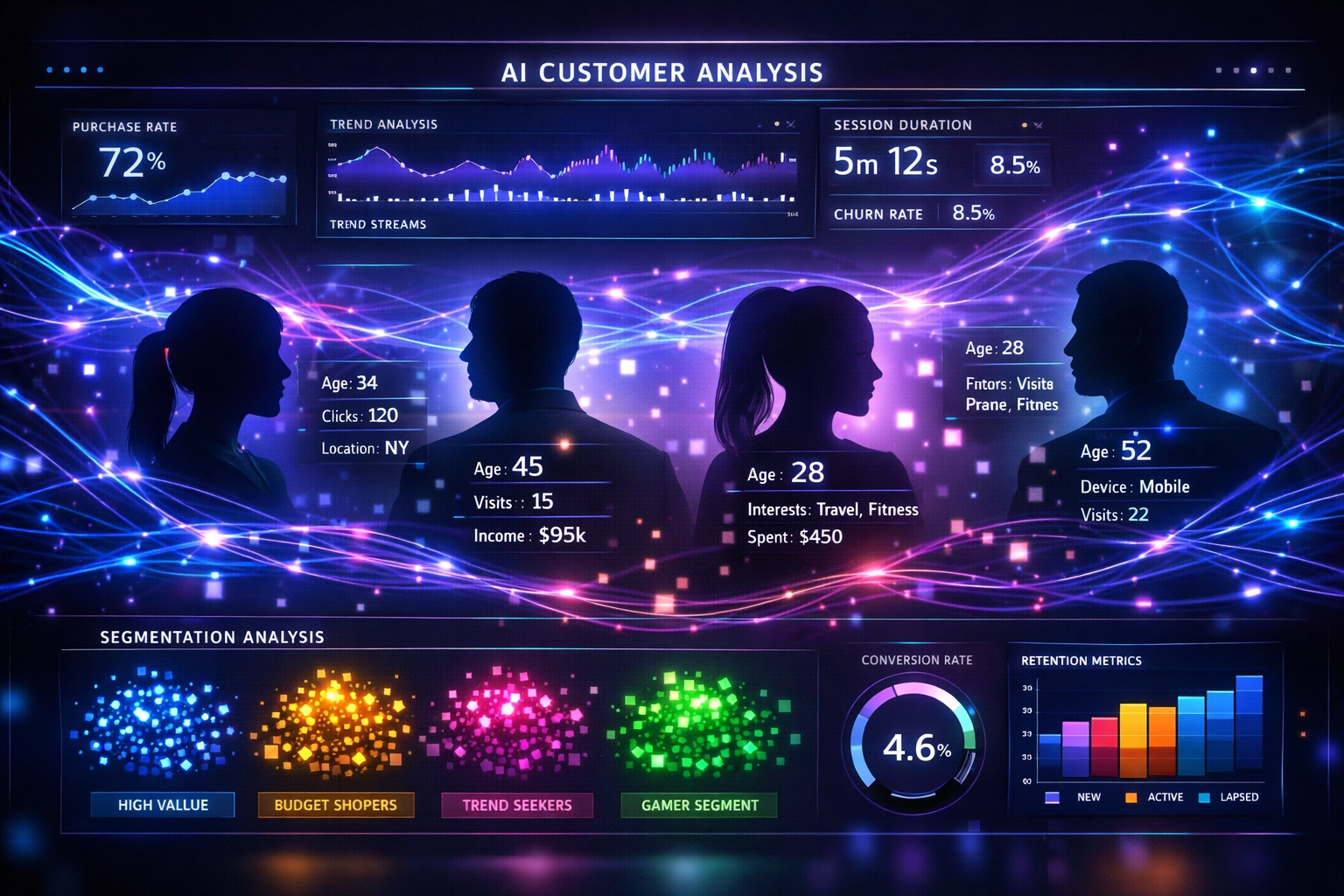
AI systems can now identify high-intent users with roughly 85% accuracy, and machine learning improves audience segmentation by 15-25%. Content production timelines that once took hours now take minutes.
But there’s an authenticity paradox: pure AI-generated content increasingly triggers consumer skepticism. Affiliates who use AI as a co-pilot rather than a replacement outperform pure AI content by 3-4x in engagement and conversions, because human review remains essential for credibility.
Playbook:
- Use AI for ideation, scaling, first drafts, and content variations.
- Reserve human effort for product testing, original photography, and authentic storytelling.
- Implement a quality-review gate on every piece of AI-assisted content before publishing.
- Track performance of AI-assisted versus fully human-written content separately, and let the data decide the mix.
Launch your affiliate program today
Set up advanced tracking in minutes. No credit card required.
Trend 2: Social Commerce Maturity
Mobile-first consumption is eliminating the friction of external links. Platforms increasingly penalize off-platform traffic in their algorithms, and in-app checkout converts 3-5x better than sending users to an external site. TikTok Shop enables direct product tagging inside videos, Instagram Reels now carry shopping overlays, and live shopping paired with user-generated content drives immediate conversions.
Playbook:
- Choose one primary platform (TikTok, Instagram, YouTube Shorts, or Pinterest) rather than spreading effort thin.
- Optimize for short-form vertical video and hook viewers in the first two seconds.
- Use native shopping features instead of external affiliate links wherever the platform supports them.
- Track conversion rate and average order value by product, not just by platform.
Trend 3: Micro- and Nano-Influencers Over Macro-Celebrities
Engagement depth is beating vanity metrics. A nano-influencer with 10,000 followers can post 8% engagement, compared to roughly 0.5% for a macro-influencer with a million followers, and nano-influencers frequently deliver 2-3x higher ROI. Audiences trust people they perceive as similar to themselves — which is also why converting existing customers into affiliates, and leaning on their authentic testimonials, consistently outperforms professionally produced content.
Playbook:
- Identify existing customers, niche creators, and micro-influencers already talking about your category.
- Use personalized recruitment outreach instead of mass emails.
- Provide content kits, but encourage creators to customize them in their own voice.
- Set up tiered commission structures
— a 5-10% base rate that climbs to 15-20% for top performers — to reward growth without overpaying newcomers.
- Track EPC (earnings per click) and retention, and compensate creators for repurposing their content.
Join our newsletter
Be the first to know about new features and product updates.
Trend 4: Multi-Touch Attribution and First-Party Data Strategy
Most customer journeys span multiple touchpoints over several days, but a last-click model only credits the final interaction. Combined with cookie collapse, that means 30-40% of conversions can go untracked entirely — and unpaid, which affiliates notice.
Server-side tracking bypasses ad blockers and browser privacy settings by sending conversion data directly from your server rather than the visitor’s browser. Paired with first-party data you actually own — email lists, customer accounts, and surveys — it lets you apply attribution models beyond last-click, including first-touch, linear, and time-decay.
Playbook:
- Audit your current tracking
setup for gaps and blind spots caused by cookie loss.
- Implement server-side tracking to capture conversions that client-side pixels miss.
- Build a first-party data strategy through email capture, account creation, and surveys.
- Choose an attribution model and communicate the rules clearly to your affiliates.
- Measure incremental lift through holdout testing, and compare affiliate revenue against management costs.
Trend 5: AI Search Optimization (GEO/AEO)
AI answer engines like ChatGPT, Perplexity, and Google AI Overviews are reshaping how people discover products and content. Being cited by these systems provides visibility even when the user never clicks through, which is why Generative Engine Optimization (GEO) and Answer Engine Optimization (AEO) are becoming their own discipline, distinct from traditional SEO.
Conversational, long-tail queries now require natural-language optimization instead of keyword stuffing. E-E-A-T (Experience, Expertise, Authoritativeness, Trustworthiness) has become a ranking signal in its own right, and original research is increasingly prioritized over content that just repackages what’s already out there.
Playbook:
- Use tools like Answer the Public, Semrush, or Ahrefs to identify question-based queries in your niche.
- Structure content to give a direct answer in the first 100 words, then expand.
- Include comparison tables and structured data that AI systems can parse easily.
- Implement JSON-LD schema markup on key pages.
- Build authority through digital PR and high-authority backlinks.
- Monitor which of your pages get cited by AI systems and double down on what works.
Flat commissions don’t account for the difference between a low-quality sign-up and a high-quality customer with a low refund rate and a high repeat-purchase rate — yet both often earn the affiliate the same payout. That gap is pushing more programs toward recurring commissions
, which pay affiliates as long as a referred customer stays subscribed. For some programs, that structure alone generates over $6,000 in annual revenue per 100 referred customers, and the resulting higher EPC is what makes affiliate marketing viable as full-time work for top performers.
Playbook:
- Calculate customer lifetime value by segment before setting rates.
- Design tiered structures — for example, 5% at the entry tier, escalating to 12% or more for top affiliates.
- Layer in performance bonuses and seasonal incentives on top of the base rate.
- For premium products, combine tiered, performance, and recurring elements into a single hybrid model.
- Communicate the math transparently, with real payout examples, and test different structures while watching affiliate retention.
Trend 7: Privacy-First Compliance and Ethical Disclosure
Regulatory pressure is tightening on every front. The FTC requires clear disclosure of compensated recommendations, GDPR and country-specific rules govern data handling and influencer disclosures, and platforms like TikTok, Instagram, and YouTube each enforce their own disclosure requirements.
Hidden sponsorships damage credibility the moment they’re discovered, while transparent disclosure measurably increases audience trust and purchase likelihood. Compliance isn’t just a legal requirement — it protects both the affiliate’s reputation and the brand’s.
Playbook:
- Establish mandatory, plain-language disclosure text for every affiliate.
- Require disclosure to be placed prominently, never hidden in a description or bio link.
- Create comprehensive affiliate guidelines covering every platform you allow.
- Provide compliance training as part of affiliate onboarding.
- Audit published content regularly for violations.
- Frame compliance to your affiliates as a competitive advantage, not just a rule to follow.
Trend 8: Niche Specialization and Vertical Expansion
Specialized affiliates outperform generalists by 2-3x, because deep expertise builds community authority and niche audiences convert at higher rates. Several verticals stand out for growth heading into 2026:
| Niche | Growth Rate | Typical Commission |
|---|
| SaaS | 25%+ | 20-50% |
| Finance / FinTech | 20%+ | Varies by product |
| Health & Wellness | 15%+ | 10-30% |
| Creator Tools | 30%+ | 20-40% |
| Sustainability | 18%+ | Emerging, low competition |
Playbook:
- Assess a niche’s market size, growth rate, competition, and profitability before committing.
- Build content authority through hands-on expertise and a genuinely unique perspective.
- Develop a vertical-specific strategy for formats, channels, and partnerships.
- Optimize for niche search terms and participate in niche communities, not just broad keywords.
- Scale depth within your niche before attempting to expand into adjacent ones.
Trend 9: Omnichannel Integration
Customers now discover products across search, social, email, video, and podcasts, and single-channel dependence leaves a program exposed to a single algorithm change. Email remains the most valuable owned channel precisely because it’s algorithm-independent: email-driven conversions tend to have a higher average order value and repeat-purchase rate, and a list of 10,000 engaged subscribers can generate $10,000-$50,000 in monthly affiliate revenue for an established creator.
Playbook:
- Audit current channels for traffic quality and ROI, not just volume.
- Set one primary channel carrying roughly 70% of effort, with secondary channels supporting it.
- Build a repurposing system that turns one blog post into video, podcast, email, and social content.
- Grow an email list deliberately through lead magnets and on-site sign-up forms.
- Implement UTM parameters and unified tracking
so performance is comparable across channels.
- Optimize each channel on its own terms — keywords for blog, segmentation for email, native format for social.
Trend 10: Global Expansion and Regional Specialization
Emerging markets are growing faster than mature ones. Latin America is growing at 20%+ with 5-15% commissions, Southeast Asia at 25%+ with rapidly growing mobile adoption, and Africa at 30%+ from a very early stage with enormous long-term potential.
Localization is the real competitive edge here — language, cultural nuance, seasonal shopping patterns, and local payment methods all require genuine adaptation, not just translation. Building relationships with local influencers is often the fastest way into a new region.
Playbook:
- Select target markets based on size, growth, competition, profitability, and regulatory environment.
- Localize content rather than simply translating it.
- Develop local case studies and testimonials specific to each market.
- Partner with local influencers and communities who already have audience trust.
- Support local payment methods and measure performance in local currency.
- Adjust strategy continuously based on region-specific data rather than a single global playbook.
The Four Pillars of the 2026 Playbook
Pulling these ten trends together, four themes define what’s working in 2026:
- Authenticity + Efficiency — human-supervised AI that scales production without sacrificing trust.
- Data-Driven Strategy — multi-touch attribution and first-party data replacing last-click guesswork.
- Specialization + Community — niche depth outperforming broad, generalist approaches.
- Omnichannel Presence — a coordinated footprint across blog, email, social, and video instead of a single channel.
The programs and affiliates who come out ahead this year are the ones combining authentic product testing with AI efficiency, investing in fair attribution systems, specializing in a niche, and keeping their practices transparent and compliant. Strategies that worked in 2024 will not work in 2026 — the fastest way to start closing that gap is to pick one trend from this list and implement it within the next 30 days.
Whichever trend you tackle first, you need tracking and commission infrastructure that can keep up. Post Affiliate Pro
supports first-party tracking, tiered and recurring commission structures, and the reporting depth to measure what’s actually working — so you can act on these trends instead of just reading about them.